
Faultsense
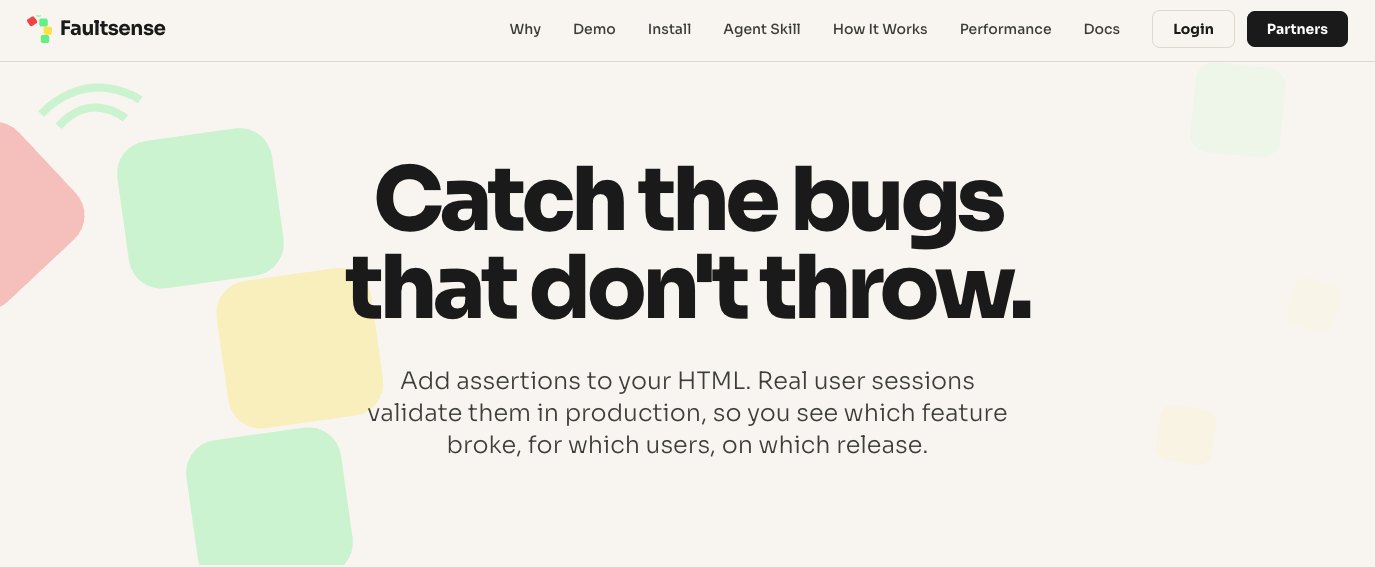
For developers: Faultsense tracks assertion failures in production across releases and cohorts, surfacing silent bugs that break conversions.
Built by Mitch Matuson · Developer Tools · Open Source · Analytics · Freemium
In category: #442 of 988 · Developer Tools
Faultsense is a Community listing on Launch Llama with 19 total upvotes, founded by Mitch Matuson who joined in May 2026, compared against 5 alternatives.
Community listing
Listing status
19upvotes
Community score
Mitch Matuson (Joined May 2026)
Founder
Compared against 5 alternatives
Market comparison
Launched on Launch Llama May 12, 2026 · #3 of 14 that day
About
“Are we sure checkout isn't broken?”
You don't actually know.
Error tracking is quiet. RUM looks normal. The funnel dipped but won't say why. So you click through on desktop, then on mobile, then ask the user for a screen recording. Faultsense answers from the assertions you wrote, validated in real user sessions, per release, per cohort. Not a chart you have to read. A structured fact: assertion, release, cohort, pass/fail.
Written like a test. Reported like a production signal. Per release, per cohort.
Use Cases
- Catching silent checkout failures in production, such as a Place Order button that completes without showing the order confirmation
- Keeping end-to-end assertions running after each deploy by validating real user flows rather than only lab tests
- Tracking which release and user cohort a broken flow affected, so teams can see who a production regression hit
Who it is for
- Developers who maintain web apps and want assertions written directly in their markup.
- Engineering teams that combine E2E testing with real user monitoring to catch production regressions.
- Teams that want to send assertion pass/fail results to their own warehouse or metrics pipeline.
Pricing
Faultsense offers a free plan plus paid tiers. See the website for current pricing.
FAQ
What is Faultsense?
For developers: Faultsense tracks assertion failures in production across releases and cohorts, surfacing silent bugs that break conversions.
How does Faultsense work?
“Are we sure checkout isn't broken?” You don't actually know. Error tracking is quiet. RUM looks normal. The funnel dipped but won't say why. So you click through on desktop, then on mobile, then ask the user for a screen recording. Faultsense answers from the assertions you wrote, validated in real user sessions, per release, per cohort. Not a chart you have to read.
Who is Faultsense for?
Faultsense is designed for a range of users, including: • Developers who maintain web apps and want assertions written directly in their markup. • Engineering teams that combine E2E testing with real user monitoring to catch production regressions. • Teams that want to send assertion pass/fail results to their own warehouse or metrics pipeline.
What can you do with Faultsense?
With Faultsense you can: • Catching silent checkout failures in production, such as a Place Order button that completes without showing the order confirmation. • Keeping end-to-end assertions running after each deploy by validating real user flows rather than only lab tests. • Tracking which release and user cohort a broken flow affected, so teams can see who a production regression hit.
Is Faultsense free?
Yes. Faultsense offers a free plan plus paid tiers. See the website for current pricing.
Alternatives
 heal.devFind bugs and vulnerabilities code review misses
More in Developer Tools
New on Launch Llama
Launched this week · This month's launches · All products A–Z
Ask AI about Faultsense
Supporters
1 founder
1 founder supported Faultsense on Launch Llama.
Third-party sources
- Simple, declarative RUM and E2E tests for web apps
Hacker News · June 19, 2026 · 2 points
- Show HN: Turn E2E tests into observability signals
Hacker News · May 8, 2026 · 3 points
For bots & AI agents
Machine-readable versions of Faultsense and Launch Llama. Fetch these instead of parsing this page.
This listing (.md) llms.txt llms-full.txt ai.txt Full catalog (.md) Endpoint index API docs MCP server MCP manifest Developer docs