
Quick Answer
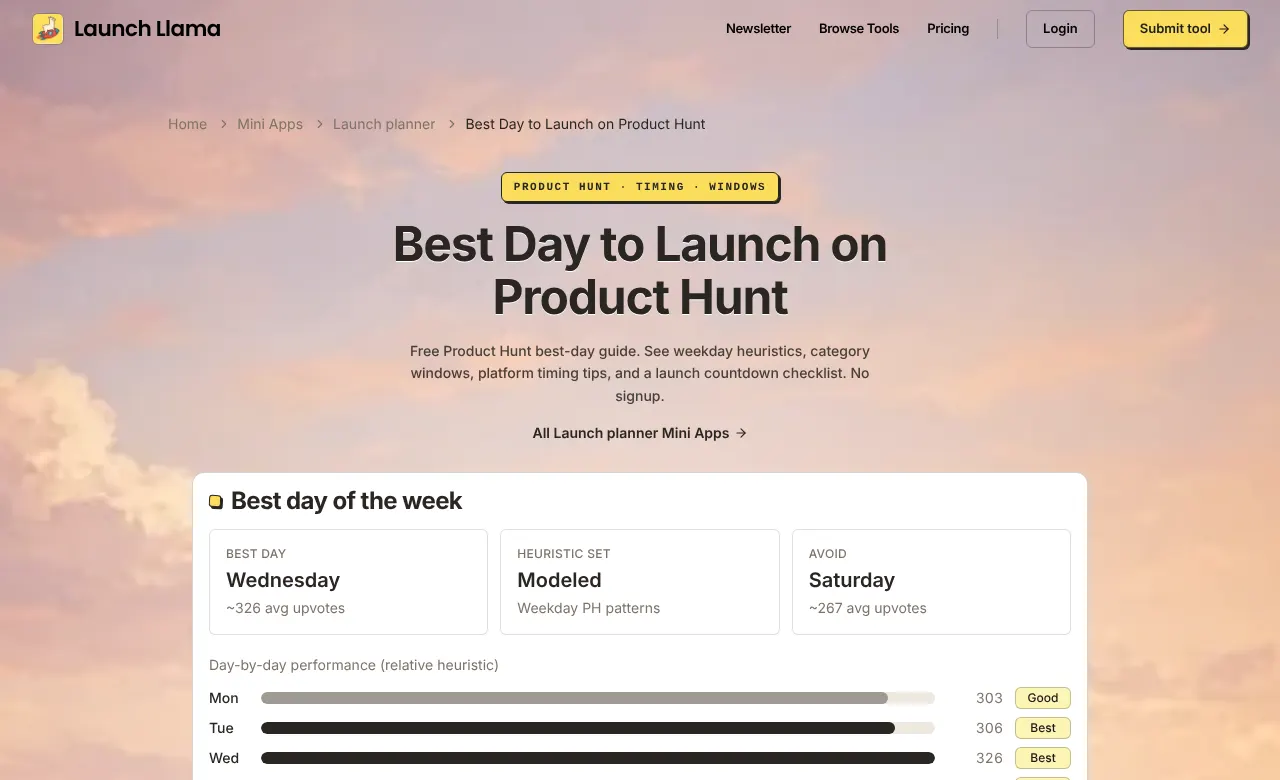
A launch marketing plan fits on one page: one goal (for example 200 sign-ups and 10 paying customers in 90 days), one buyer, one message, three to five channels, a calendar from 30 days before launch to 60 days after, and four numbers to track weekly. The calendar matters most: the slow channels (directories, a free launch listing, newsletters, search) have to start a month early, and most of the results come in the 60 days after launch day, not on it. Time the public launch to the platform: on Launch Llama, free listings that went live on a Monday got 1.49% click-through, against 0.40% to 0.54% for Thursday to Sunday. And go live with proof: listings with 3+ reviews got 3.61% against 0.87% with none.
Key takeaways
- One page: goal, buyer, message, channels, calendar, numbers.
- Start 30 days before launch with the slow channels.
- Plan 60 days after launch, where most results come from.
- Three to five channels, each with an owner and a weekly task.
- Track four numbers weekly: visitors, sign-ups, activation and paying customers.
The one-page plan
If you can't fill a row, that's the first thing to work on. See go-to-market strategy for startups for the bigger picture.
Choose your channels
Pick three to five from this list, based on where your buyer already is:
The 90-day calendar
Days -30 to -1: prepare
The full list is in the pre-launch checklist.
Days 0 to 7: launch week
Days 8 to 30: follow-through
- One newsletter feature or cross-promotion a week.
- One post a week about what you learned from users.
- One review request a week to users who got a good result.
- A second launch platform in week 3 (Product Hunt or Show HN if you have supporters and proof).
- Fix the top three onboarding problems.
Days 31 to 90: compound
- One search page a week: alternatives, comparisons, use cases.
- Double down on the two channels that brought active users.
- Drop the channel that brought nothing.
- Test one paid channel with a small budget once you know what a customer is worth.
- Ask early customers for case studies.
Time it to the platform
On Launch Llama, free listings that went live on a Monday got 1.49% click-through, against 1.07% to 1.35% on Tuesday and Wednesday and 0.40% to 0.54% for Thursday to Sunday. More in the best day to launch.
Go live with proof
Free founder listings on Launch Llama, May 4 to November 15, 2026. Correlations, not controlled tests.
Track four numbers every week
Review them every Friday and change one thing a week. Our free MRR growth calculator projects where you'll be at day 90.
Budget options
Keep reading
- Go-to-Market Strategy for Startups: A Practical Plan for Your First Launch (2026)
- What to Do Before Launch Day: A Pre-Launch Checklist for Startups (4 Weeks Out to Launch Morning, 2026)
- How to Launch a Product Successfully in 2026: The Launch Plan Our Best Listings Followed
- How to Market a SaaS Product in 2026: Channels, Order and What Worked on 1,381 SaaS Listings
Frequently asked questions
What should a launch marketing plan include?
A goal, the buyer, the message, three to five channels, a calendar from 30 days before launch to 60 days after, a budget and four numbers to track weekly.
When should I start marketing before launch?
About 30 days before. Directories, launch listings and newsletters take weeks, and you need time to collect reviews and screenshots.
How many marketing channels should a startup use at launch?
Three to five, each with a weekly task. Drop the ones that bring nothing after a month.
What should I do after launch day?
Keep going for 60 days: newsletter features, posts about what you learned, review requests, a second launch platform and search pages.
How much budget do I need for a launch?
You can launch for $0. Small budgets go furthest on a dated launch listing, one newsletter ad or a few weeks of featured placement.
Start your plan on Monday
Go live when the week resets.
A free Launch Llama listing enters the weekly leaderboard: top 5 get a permanent dofollow backlink and #1 goes out to 69,000+ subscribers. Instant Launch lets you pick the day.
Launch your product →