
FunnelCanary
Paste your funnel URL. FunnelCanary scans links, forms, redi
Developer Tools
Advertise here
Featured · dofollow included
Open slot →

Merch Push
Effortless branded apparel distribution for teams
Startups
Advertise here
Featured · dofollow included
Open slot →

laserbrain · smart recursion harness + recursion monitor
A fixed grammatical score relative to any grammatical goal.
Artificial Intelligence
Advertise here
Featured · dofollow included
Open slot →

Commune
The home base for indie makers, builders, and founders.
Community
Mappit
Earth's zeitgeist, on a map. Every place has a story.
Social Media
FunnelCanary
Paste your funnel URL. FunnelCanary scans links, forms, redi
Developer Tools
Advertise here
Featured · dofollow included
Open slot →
Merch Push
Effortless branded apparel distribution for teams
Startups
Advertise here
Featured · dofollow included
Open slot →
laserbrain · smart recursion harness + recursion monitor
A fixed grammatical score relative to any grammatical goal.
Artificial Intelligence
Advertise here
Featured · dofollow included
Open slot →
Commune
The home base for indie makers, builders, and founders.
Community
Mappit
Earth's zeitgeist, on a map. Every place has a story.
Social Media
Auto-scrolls · Hover to pause
100+ Places to Launch Your Startup for Free
March 27, 2026 · 25 min read
Most founders spend months building in silence, then launch to crickets. The platforms you choose — and the order you use them — determines whether your launch generates 10 users or 10,000. Here's what the playbook actually looks like in 2026.
Free to submit. No catch. Takes 10 seconds.
Why Most Founders Get Launch Platforms Wrong
Here's the scenario that plays out for thousands of founders every single year: you spend six months building a product, you deploy it to production, you tweet about it once, and then you wait. And wait. And wait. The silence is deafening.
The problem isn't the product. The problem is the launch strategy — or the complete absence of one. Most founders treat launching as a single event rather than a multi-channel, multi-week distribution campaign. They pick one platform, get underwhelming results, and conclude that "organic launch doesn't work." Meanwhile, the founders who actually crack early traction are methodically working through a tiered stack of platforms, communities, and directories — most of which are completely free to use.
The other massive mistake? Trying to do everything at once. Submitting to 250 platforms in a single chaotic afternoon is not a strategy. It's noise. The founders who win are the ones who understand the hierarchy: some platforms can send you 10,000 visitors in 24 hours, others build slow-burn SEO authority over months, and communities require relationship-building long before you ever mention your product.
This guide is the definitive resource on startup launch platforms for founders in 2026. We've mapped out 100+ platforms ranked by real impact, organized into actionable tiers, and paired them with a week-by-week execution playbook. Whether you're launching a SaaS product, a mobile app, an AI tool, or a developer utility, this is the distribution strategy that the most successful early-stage founders are actually using right now.
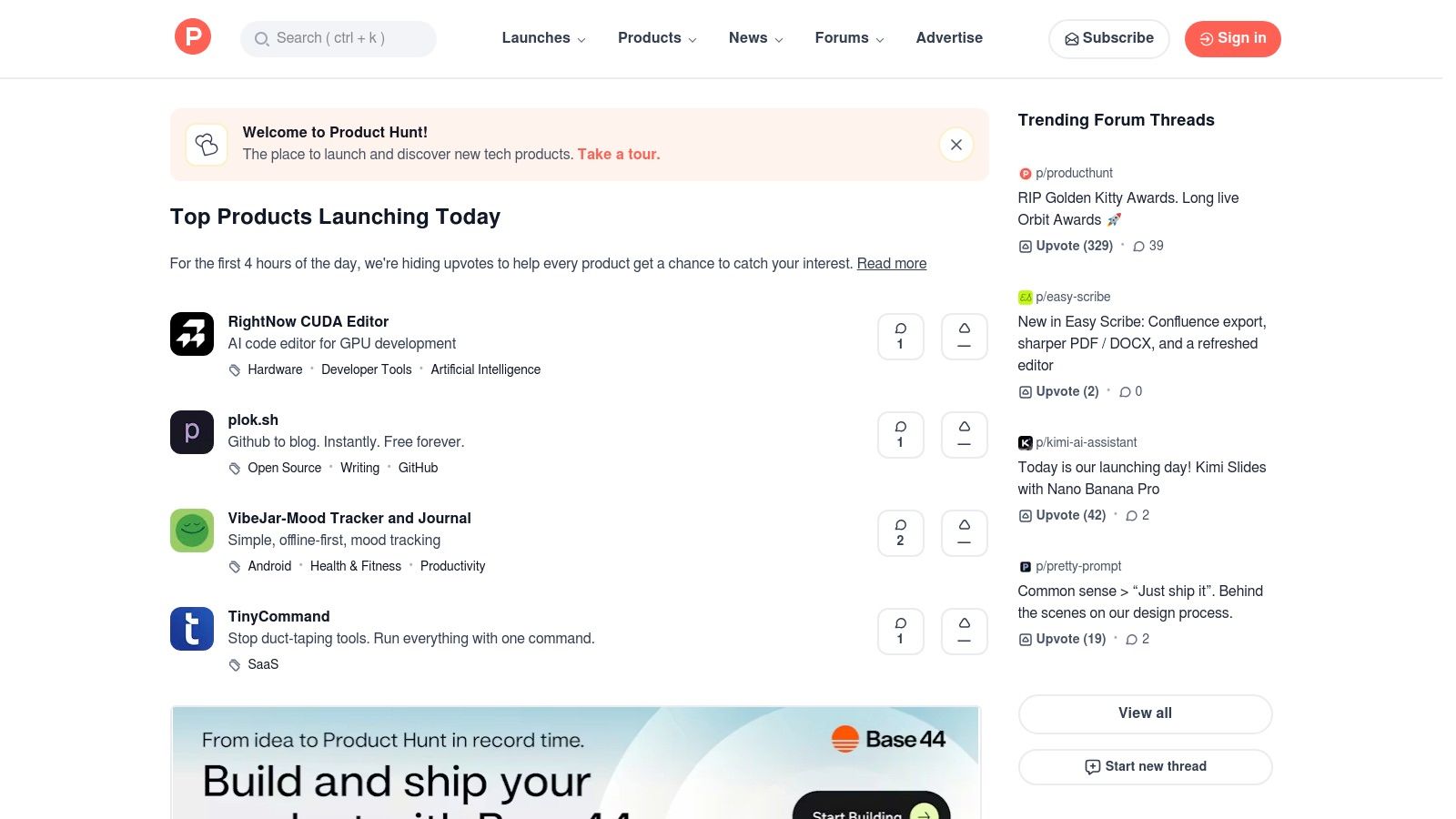
Tier 1 — The Big Launchers (Start Here)
These are the platforms that can fundamentally change your trajectory overnight. A top-5 finish on Product Hunt can drive between 5,000 and 20,000 visitors in a single day. A front-page Hacker News post can send 10,000+ visitors within hours. If you only have bandwidth for ten platforms total, these are the ten.
| # | Platform | Why It Matters | Impact |
|---|---|---|---|
| 1 | Product Hunt | The gold standard for product launches. Daily ranking drives massive visibility. | 5,000–20,000 visitors/day |
| 2 | Hacker News (Show HN) | Post a clear, no-fluff "Show HN" description. Front page = massive developer traffic. | 10,000+ visitors in hours |
| 3 | Reddit r/SaaS | 200,000+ members. Share your story, not your pitch. Community-first wins. | High — if authentic |
| 4 | Reddit r/startups | Weekly "Share Your Startup" threads. Read the rules carefully. | Medium-High |
| 5 | Reddit r/SideProject | More forgiving than r/startups. Great for MVPs and early-stage validation. | Medium-High |
| 6 | Indie Hackers | The founder community. Share revenue numbers, build in public. | High quality traffic |
| 7 | BetaList | Curated directory of startups in beta. Free tier available. | Medium |
| 8 | DevHunt | Product Hunt specifically for developer tools. Mandatory for dev SaaS. | High for dev tools |
| 9 | Dev.to | Write a technical post about how you built your product. Strong SEO signals. | Long-term SEO |
| 10 | Medium | Publish your launch story. Medium articles rank fast on Google. | SEO + Authority |
Don't just launch and disappear. Use Product Hunt continuously to monitor top mobile apps and SaaS tools in your niche. Analyze launch-day comments for user feedback like "I wish it had X integration" — this is free, unfiltered market research that most founders ignore completely.
Recommended Read
Submit Your AI Tool Free & Get Featured In Our NewsletterTier 2 — High-Quality Directories for SEO & Backlinks
While Tier 1 platforms generate explosive short-term spikes, Tier 2 is where you build the compounding foundation that pays dividends for years. These are established software review sites and directories that buyers actively use when comparing tools before purchasing.
The Gartner-owned trio — Capterra, GetApp, and Software Advice — deserves special attention. Enterprise and mid-market buyers routinely use these platforms during procurement. These listings are free and take less than an hour to set up.
- G2 — The most trusted B2B software review site. A profile with 5+ reviews becomes a conversion asset.
- Capterra — Owned by Gartner. Buyers actively compare tools here before purchasing.
- AlternativeTo — People search "alternative to [competitor]" constantly. Steal traffic from established players.
- SaaSHub — Clean SaaS directory that ranks well for "[product] alternatives" queries.
- GetApp — Sister site of Capterra. Same enterprise buyer audience.
- Software Advice — Also Gartner-owned. Completes the trifecta with another high-DA backlink.
- Trustpilot — A profile with reviews builds massive social trust. Free to claim.
- TrustRadius — In-depth enterprise software reviews. Reviews carry weight with procurement teams.
- StackShare — Developers use StackShare to discover tools for their tech stack.
- Crunchbase — A Crunchbase profile adds legitimacy and ranks well for company name searches.
- Clutch — B2B ratings and reviews. Strong domain authority and backlink value.
- GoodFirms — Software review platform. High DA backlink opportunity.
- Tekpon — Growing SaaS review platform with editorial reviews.
- SoftwareSuggest — Good global reach. Free listing with solid international traffic.
- CrozDesk — Business software marketplace with its own Crozscore rating system.
- SaaSworthy — SaaS discovery platform with comparison features.
- FinancesOnline — They write the review for you. Free expert review with strong SEO value.
- Serchen — Cloud services directory with integrated reviews.
- PeerSpot — Enterprise tech reviews. Strong with IT decision-makers.
- Slant — Community-driven product recommendations.
Tier 3 — Startup Launch Platforms Built for Founders
This tier is where the newer, founder-friendly launch platforms live — platforms specifically designed for the early-stage product launch experience. Think of these as the rising challengers to Product Hunt: smaller, more intimate communities where a quality submission can still generate meaningful traction.
Tier 4 — Startup Directories: Cast a Wide Net
Tier 4 is your volume play. Each of these directories is a backlink and a discovery channel. None of them will individually change your trajectory, but collectively — submitted in a single focused afternoon — they create a distributed web presence that boosts your domain authority.
Key platforms include Wellfound (AngelList) for startup credibility, F6S for accelerator access, Startup Stash for curated resources, and Killer Startups — one of the oldest directories, operating since 2005. Other valuable Tier 4 directories include: Startup Base, Startup Ranking, Startup Buffer, AllTopStartups, Early Shark, Startup Dope, Startup88, Startup Stage, Startup Inspire, The Startup INC, The Startup Pitch, Crazy About Startups, Startups FYI, Tiny Startups, and BigStartups.
Tier 5 — AI Tool Directories (Non-Negotiable if You Have AI)
If your product has any AI component — even a single AI-powered feature — these directories are non-negotiable. The AI tools category is one of the fastest-growing discovery segments on the internet.
| Directory | Monthly Visitors | Notable Feature |
|---|---|---|
| There's An AI For That | 500,000+ | The biggest AI tool directory on the web. |
| Futurepedia | 5M+ | One of the highest-traffic AI directories. Excellent SEO. |
| Future Tools | Large | Curated by Matt Wolfe. YouTube audience amplifies discovery. |
| Toolify AI | Growing | Strong SEO. Ranks well for specific AI tool categories. |
| Dang AI | Growing | Fast-growing AI tools directory with active curation. |
| All Things AI | Established | Comprehensive AI tools and resources directory. |
| AI Tool Hunt | Growing | AI tool discovery platform with community voting. |
| SaaS AI Tools | Niche | AI tools specifically curated for SaaS builders. |
Tier 6 — Communities and Forums
Communities are fundamentally different from directories. You cannot treat them like a submission form. The founders who extract the most value are the ones who show up consistently, answer questions, share genuine insights, and build relationships — long before they ever mention their own product.
Done right, communities are your highest-quality traffic source. A front-page post on Reddit r/InternetIsBeautiful can send 50,000+ visitors. A thoughtful post on Reddit r/Entrepreneur — 3 million members — that genuinely helps people can drive hundreds of qualified sign-ups.
- Reddit r/Entrepreneur — 3M+ members. Value-first posting is the only strategy that works.
- Reddit r/InternetIsBeautiful — A front-page post can send 50,000+ visitors in a single day.
- Reddit r/GrowthHacking — Share what worked for you, not what you're selling.
- Reddit r/smallbusiness — If your SaaS targets SMBs, this is your most relevant audience.
- GrowthHackers — Growth marketing community. Thought leadership drives discovery.
- WIP.co — Build in public with accountability. Transparent progress builds trust.
- No Code Founders — If you built with no-code tools, this community is highly aligned.
- HackerNoon — Publish technical articles with strong SEO. Great for dev products.
- GitHub — If any part of your product is open source, a well-documented repo is your best growth channel.
Spend at least 4 weeks contributing value to a community before you mention your product. Answer questions, share case studies, help other founders. When you do eventually share your product, the community will already know and trust you — and that trust converts into users.
Tier 7 — Tool Aggregators and Curated Lists
Tool aggregators are the long-tail discovery channels that generate steady, passive referral traffic from people actively browsing for tools to solve specific problems. Key platforms include 1000.tools, Resource FYI, CtrlAlt.cc, Tool Finder, NoCode List, OpenAlternative, Find Cool Tools, Twelve Tools, PostMake, and Awesome Indie.
Tier 8 — Beta Testing, Marketplaces & Showcases
AppSumo deserves special attention here. A successful AppSumo listing can generate hundreds of thousands of dollars in lifetime deal revenue while simultaneously flooding your user base with paying customers. PitchGround serves as a strong alternative.
For design-conscious founders, Land-book and One Page Love showcase exceptional landing pages and drive significant referral traffic. If your SaaS integrates with Zapier, the Zapier App Directory is free to list in and provides access to Zapier's massive user base.
Bonus: Best Tools for Founders Building Mobile Products
1. RapidNative — AI-Powered Mobile UI Generation
RapidNative is an AI-powered platform that dramatically shortens the distance between a mobile app idea and a functional, developer-ready prototype. It generates clean, production-grade React Native code that developers can actually use and build upon.
- Generates real, exportable React Native code
- Multiple input methods (text, image, whiteboard)
- Incredibly fast prototyping cycles
- Modular, clean, developer-friendly outputs
- UI/navigation focus only; no backend
- Request limits; credits don't roll over
- Complex logic requires manual coding
- Still an emerging tool
2. Product Hunt — Market Research & Launch
Product Hunt is not just a launch platform — it's an ongoing competitive intelligence tool. Before building your fitness app, search for "workout tracker" to gauge existing competition. Analyze launch-day comments for free, unfiltered market research.
The Launch Execution Playbook (Week-by-Week)
The single biggest mistake founders make with this list is trying to submit to all 250 platforms in one chaotic day. Here's the structured playbook that actually works:
These are your highest-impact channels. Spend serious time here. Craft your Product Hunt launch carefully — write a compelling tagline, prepare maker comments, and line up supporters.
Time investment: 8–15 hours across the week.
Submit to G2, Capterra, AlternativeTo, SaaSHub, GetApp, Software Advice, Trustpilot, TrustRadius, StackShare, and Crunchbase. These are your SEO foundations.
Time investment: 2–4 hours. Most profiles take 15–20 minutes each.
Work through the remaining tiers systematically. Use a spreadsheet to track where you've submitted and when. Batch similar platforms together.
Time investment: 1–2 hours per day across two weeks.
Communities are not a one-time thing. Show up regularly, add value, build relationships. The founders who get the most from Reddit and Indie Hackers are the ones who contribute before they promote.
Time investment: 30–60 minutes per day. Highest ROI activity.
150 Bonus Platforms — The Extended List
Already submitted to the top 100? Here are 150 more directories and platforms worth your time. Most take 5–10 minutes to submit:
More Startup Directories
- Startup Lister
- StartupBlink
- Cool Startups
- Startup Lift
- Startup Guys
- Startup-Buzz
- Startup Beat
- Startup World
- Startup Tracker
- Startupanz
- Startup Collections
- Startup Roulette
- Startup Europe
- Magnitt
- SnapMunk
- Startup Spotlight
- Product Burst
- Firsto
- Launched.io
- Super Launch
More SaaS Directories
- Oksaas.co
- SaaS Genius
- SaaS Gallery
- SaaS Surf
- SaaSPo
- GetLatka
- Open SaaS Directory
- SpotSaaS
- SoftwareWorld
- CrowdReviews
- Sitejabber
More AI Tool Directories
- AI Tools Directory
- Insidr AI
- AI Center
- AI Scout
- That AI Collection
- Aixploria
- AI Tools FYI
- Best of AI
- Neil Patel AI Tools
- Tool Pilot
- Mars AI Directory
- Ben's Bites News
- Supertools
- Open Future AI
- Top Apps AI
- GPT Academy
- Whatsthebigdata
Communities & Forums
- Reddit r/productivity
- Reddit r/AppIdeas
- Reddit r/Business_Ideas
- Reddit r/buildinpublic
- Makerlog
- Pioneer.app
- The Hive Index
- Nocode Devs
- Unita
- DevPost
Media & Press
- TechCrunch
- Ceowire.co
- VentureBeat
- The Next Web
- Mashable
- GeekWire
- Tech.eu
- BetaKit
- Inc42
- Tech in Asia
- Feedough
- Springwise
- Starter Story
Tool Aggregators
- Robin Good's Tools
- Insanely Cool Tools
- Toools.design
- Internet is Beautiful
- Extend Hunt
- Indie Products
- Buffer Apps
- Early.tools
- Once.tools
- 700.tools
- Indie Tool
- Hand Picked Tools
- Alternative.me
Beta & Marketplaces
- BetaBound
- Betafy
- Prefinery
- Dealify
- StackSocial
- Acquire
- Gumroad
Design Showcases
- Curated.design
- WebDesign Inspiration
- SaaS Screenshots
If you run a newsletter alongside your product (which you should), submit to Letterlist, InboxReads, and The Sample. These platforms surface newsletters to readers actively looking for new subscriptions.
Final Verdict & Key Takeaways
The platforms on this list have collectively helped thousands of SaaS and mobile app founders go from zero to their first 1,000 users — without spending a single dollar on ads.
- Treating launch as a single event — it's a multi-week, multi-channel campaign.
- Skipping the SEO tier — directories like G2, Capterra, and AlternativeTo compound over years.
- Spamming communities — contribute first, promote later.
- Ignoring AI directories — if your product has any AI feature, these directories represent millions of monthly visitors.
- Trying to do everything at once — follow the tiered playbook. Consistency beats chaos.
Whether you're launching a SaaS product, a mobile app, or an AI-powered developer utility, the distribution strategy is the same: start with the platforms that drive the most traffic, build your SEO foundation in parallel, and invest in communities for long-term compounding growth.
The founders who win aren't the ones with the biggest budgets. They're the ones with the best distribution strategy. Now you have it.
Free to submit. No catch. Takes 10 seconds.
Join 3,000+ founders & AI builders
Get our best-selling resources free — worth $197. No spam.
Comments
No comments yet. Be the first!
📚 Related Articles
Submit Your AI Tool Free & Get Featured
List your AI tool for free on Launch Llama. Top submissions are featured weekly to 65,000 subscribers. No cost, ever.
How to Launch a New Product: The 30-Day Playbook
A step-by-step guide to launching your product in 30 days, from pre-launch buzz to post-launch growth.
Product Hunt Alternatives in 2026: Where to Launch Your Product
Beyond Product Hunt: discover the best platforms to launch and promote your startup in 2026.
🦙 30 Tools to Generate More Leads as a Founder
Discover the best tools to generate more leads — Product Hunt tools and featured premium community listings on Launch Llama.
Browse tools by category

Hey, I'm Tom 👋
I spent years launching my own products and getting nowhere fast — hours lost on manual directory submissions, chasing backlinks one by one, copy-pasting the same product description into fifty different forms.
So I built Launch Llama. Newsletter placements in front of founders who actually buy. Directory listings that send real traffic. Backlinks that build lasting authority. One service, done properly — so you can focus on building.
If you want to figure out which package fits where you're at, just message me.