
Quick Answer
Validate an idea by testing the riskiest assumption first, which is almost always "people have this problem badly enough to change what they do". In two to four weeks: write the problem in one sentence, find 20 people who have it and ask how they handle it today, put up a one-page site with a clear promise and a sign-up, send people to it, and ask for money or a commitment from the most interested. Strong signals: people describe the problem before you do, they already pay for a workaround, and some agree to pay or pre-order. Weak signals: compliments, "I'd use that", and likes. Competition is usually a good sign: on Launch Llama, AI has 3,087 listings and still added 707 in the last 90 days, because buyers keep looking.
Key takeaways
- Test the problem first, then the solution, then the price.
- 20 conversations with people who have the problem beat 200 survey answers.
- A one-page site and a price test demand before you build.
- Money and time are the only real signals. Compliments aren't.
- Competition means there's a market. Find the part of it nobody serves well.
What validation actually means
Validation isn't proof that an idea will work. It's evidence that the riskiest parts are less risky than you feared. Test them in this order:
Most failed startups skip the first row.
Step 1: write the problem in one sentence
"Agency owners spend a day a month building client reports by hand." Not "Reporting is broken." The sentence names a person, a job and a cost. If you can't write it, you're not ready to test.
Step 2: find 20 people who have it
- Search for how people complain about it: "how do I [task]", "[tool] alternative", "[task] takes forever" on Reddit, X, LinkedIn and forums.
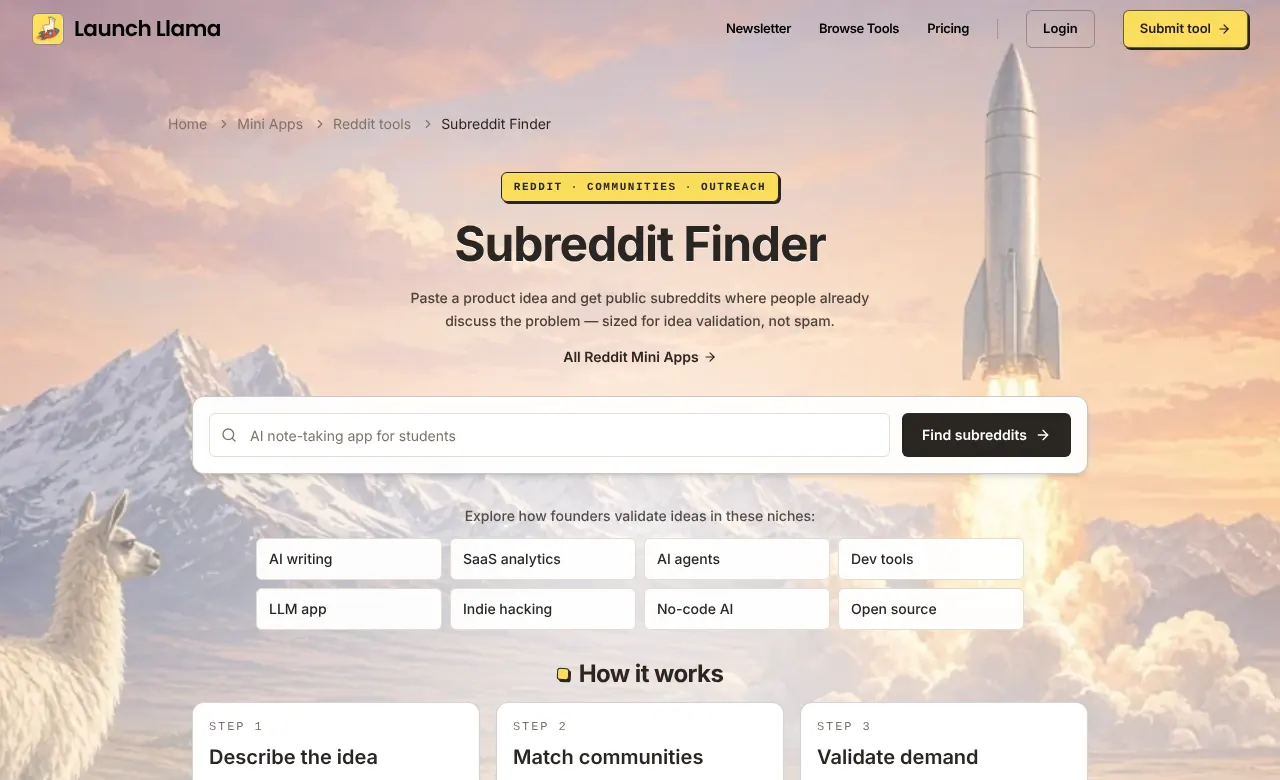
- Look at communities where your buyer gathers. Our free subreddit finder finds subreddits where people discuss your problem.
- Ask your network for introductions to people with the job title.
- Read competitors' reviews. Two- and three-star reviews describe what's missing.
Step 3: talk to them (and don't pitch)
Ask about the past, not the future:
Listen for three things: they bring up the problem without prompting, they've already tried to solve it (a spreadsheet, a freelancer, a paid tool), and it happens often enough to matter.
Step 4: put up a one-page site
One page with: a headline naming the job and the person, one image of the product (a mockup is fine), what they get for signing up, and one email field. See how to build a waitlist from zero.
Then send people to it from the places in step 2. A page nobody visits validates nothing.
Step 5: ask for a commitment
The strongest signal is money. Ways to ask before the product exists:
- A pre-order with a launch discount, refundable if you don't ship.
- A paid pilot: "I'll set it up for you by hand for $200 for the first month."
- A letter of intent for B2B buyers.
- A concierge version: do the job manually for 3 customers and charge them.
Time is the second-best signal: someone who books a second call or sends you their real data is interested.
How to read the signals
A rough rule: if fewer than a few of your 20 conversations produce a strong signal, change the buyer or the problem before you build.
Is competition a bad sign?
Usually it's a good one. It means people are looking for a solution and paying for one. What matters is whether you can serve one group better than the general tools do.
Our own listings show it. AI is the most crowded category on Launch Llama, and new tools keep arriving because demand keeps growing:
src/data/research-stats.mjs listings.categories, snapshot November 14, 2026. Listings can sit in more than one category.
Crowded categories with lots of new entries tell you buyers are there. Your job is to find the slice nobody serves well: a specific industry, team size or workflow.
Ways to validate without building
- A demo video of a clickable prototype (Figma or no-code).
- A manual version where you do the work behind the scenes.
- A spreadsheet or template that solves part of the problem, given away free.
- A free mini tool (a calculator, a checker) that shows whether people come for the problem.
How long validation should take
Two to four weeks for most software ideas: one week to find people and talk, one week for the page and the first visitors, and one or two weeks to ask for commitments. If it's taking months, you're probably avoiding the step where you ask for money.
Keep reading
- How to Build a Waitlist or Email List From Zero Before You Launch (2026)
- How to Find Beta Testers for Your Startup (and Get Feedback You Can Use, 2026)
- How to Get Your First Paying Customer (When You Have Users but Nobody Pays, 2026)
- Go-to-Market Strategy for Startups: A Practical Plan for Your First Launch (2026)
Frequently asked questions
How do I validate a startup idea?
Write the problem in one sentence, talk to 20 people who have it, put up a one-page site with a sign-up, send people to it, and ask the most interested for a pre-order or paid pilot.
How many people should I talk to?
About 20 people who have the problem. Patterns usually show up after 10 to 15 conversations.
What's the best signal that an idea is validated?
Someone paying or committing before the product exists: a pre-order, a paid pilot or a letter of intent.
Is it bad if there are competitors?
Usually not. Competition shows people are looking and paying. Find the group the existing tools serve badly.
How long does validation take?
Two to four weeks for most software ideas. Longer usually means the step of asking for money is being avoided.
Test it in public
List your idea and see who clicks.
Pre-launch products can list on Launch Llama for free: a permanent page with a link to your waitlist, reviews from founders and a place on the weekly leaderboard.
List your product →