metis
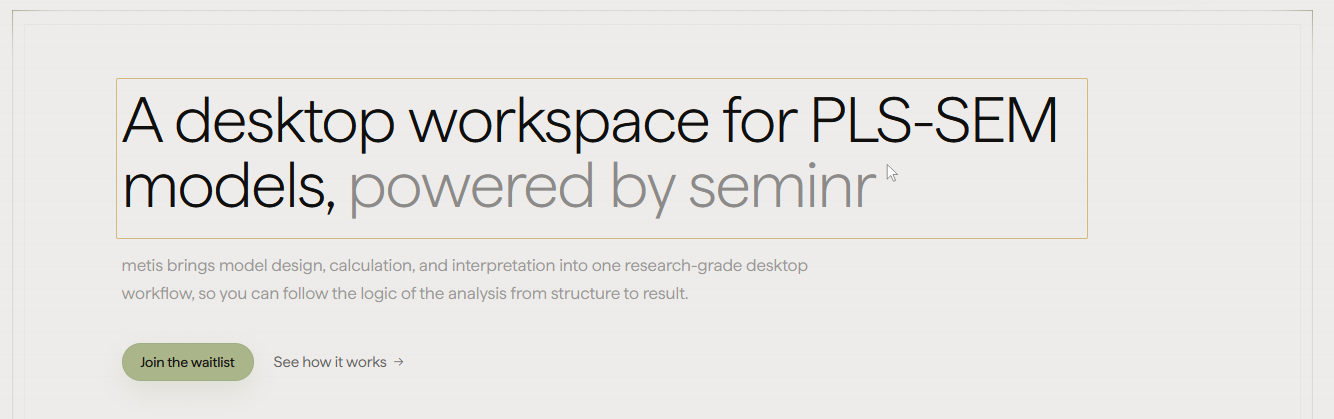
For researchers and students: Metis is a free desktop app for PLS-SEM analysis. Build models visually, import data, and explore results without coding or subscriptions.
Built by Aaron Akuteye · Productivity · Design Tools · Education · Free
In category: #528 of 1429 · Productivity
metis is an Instant Launch listing on Launch Llama with 27 total upvotes, founded by Aaron Akuteye who joined in May 2026, compared against 6 alternatives.
Instant Launch listing
Listing status
27upvotes
Community score
Aaron Akuteye (Joined May 2026)
Founder
Compared against 6 alternatives
Market comparison
Launched on Launch Llama May 22, 2026 · #6 of 26 that day
About
Research should feel challenging
because of the ideas
not the software.
That belief is what led to the creation of Metis.
Metis is a free desktop application designed to make PLS-SEM more approachable for students, researchers, lecturers, and academic teams. It was built for people who want to focus on understanding their models and interpreting results, instead of struggling through complicated software or technical coding requirements. Metis was developed to remove some of these barriers like cost and subscription and create a smoother, more supportive experience for research analysis.
With Metis, users can visually build their models, import datasets, run analyses, and explore results through a guided workflow that feels clear and practical. Although the software is powered by R and SEMinR, users do not need to write code to use it. The goal is to make advanced statistical analysis more accessible without sacrificing academic quality. You could still export your results as R code or import R code of any previous analysis you have done in R.
Metis is not taking challenging R users but making sure they can get a nice graphical output of their path model while keeping their code.
Follow metis: LinkedIn
Use Cases
- Estimating a PLS-SEM technology acceptance model (TAM) from a survey dataset for a thesis or journal paper
- Running PLS-SEM bootstrapping, PLSpredict, and IPMA without writing R code
- Exporting journal-ready Word tables and path diagrams from saved PLS-SEM results
Who it is for
- Researchers and students who need a free PLS-SEM analysis tool.
- Academic teams working on structural equation modelling studies with private local datasets.
Pricing
metis is free to use. See the website for details.
metis at a glance
- 01What it is
- metis: For researchers and students: Metis is a free desktop app for PLS-SEM analysis. Build models visually, import data, and explore results without coding or subscriptions.
- 02Pricing
- metis pricing: Free.
- 03Best for
- metis is best for researchers and students who need a free PLS-SEM analysis tool. and academic teams working on structural equation modelling studies with private local datasets.
- 04Alternatives
- Top metis alternatives on Launch Llama: DataTistics, ipynb.app and PulseLake.
FAQ
What is Metis?
Metis is a desktop application for Partial Least Squares Structural Equation Modelling (PLS-SEM). It brings dataset management, visual model building, statistical analysis, results exploration, and reporting into one workspace. Statistical calculations run through R, primarily using seminr, while Metis provides the visual workflow around the analysis.
Which installer should I choose: Bundle or Lite?
Both installers provide the same Metis application. Bundle is recommended for most users—it includes the complete R calculation environment and does not require installing R separately. Lite is intended for users who already have R installed.
Do I need to know R to use Metis?
No. Metis uses R in the background, but normal model building, analysis and reporting are performed through the graphical interface. Users who want to inspect or reproduce their analysis in R can also export or copy the corresponding R script.
Does my dataset leave my computer?
No. Model data, calculations, workspaces, saved results and Tark reports are processed and stored locally on your computer. Metis does not require your research dataset to be uploaded to a cloud analysis service.
Is Metis free?
Yes. Metis is distributed free of charge and released under the GNU General Public Licence v3 (GPL-3). There is no subscription required to run analyses.
What analyses are currently available in Metis?
The workflow includes PLS-SEM, Bootstrapping, PLSpredict, CVPAT, Importance-Performance Map Analysis (IPMA), Necessary Condition Analysis (NCA), combined cIPMA, 3-stage MICOM measurement invariance, Multigroup Analysis (MGA), higher-order constructs, moderation analysis, and automated Tark reporting.
What is Tark?
Tark is the reporting assistant built into Metis. It collects selected saved results and converts them into structured tables and optional model diagrams for use in a thesis, dissertation, paper or report, significantly reducing repetitive formatting work.
Can I use Metis for a thesis, dissertation or journal article?
Yes. Metis is designed for academic research workflows. For the current release, cite Metis in-text as (Metis, 2026) and seminr as (Ringle et al., 2024) .
Alternatives
 DataTisticsDataTistics helps students, researchers, and analysts clean, analyze, and visualize data without coding. Upload your dataset, run statistical tests and get insights and reports in minutes.
 ipynb.appFor data scientists: ipynb.app converts Jupyter notebooks to PDF, Word, and HTML instantly without installation so you share analysis faster.
 PulseLakeFor research teams: PulseLake organizes studies around reusable ontologies, automating survey design, analysis, and insight delivery across quantitative and qualitative data.
More in Productivity
New on Launch Llama
Launched this week · This month's launches · All products A–Z
Ask AI about metis
Supporters
1 founder
1 founder supported metis on Launch Llama.
Reviews
1 comment
Metis was created to make research easier for everyone. While working as a student assistant, I saw that many talented researchers struggled because current statistical software is too complicated and requires coding skills. I wanted to build a tool that handles the hard math behind the scenes so that anyone, no matter their technical background, can focus on solving important problems instead of fighting with software. It has been amazing to see how people are using Metis in ways I never expected, and it shows that researchers really need tools that are simple, accessible, and mission-driven.
For bots & AI agents
Machine-readable versions of metis and Launch Llama. Fetch these instead of parsing this page.
This listing (.md) llms.txt llms-full.txt ai.txt Full catalog (.md) Endpoint index API docs MCP server MCP manifest Developer docs