
Autheo
For developers: Autheo unifies identity, compute, storage, and AI on a Layer-0 OS with integrated blockchain—one interoperable environment.
Built by Todd · Developer Tools · Freemium
In category: #379 of 988 · Developer Tools
Autheo is a Community listing on Launch Llama with 26 total upvotes, founded by Todd who joined in May 2026, compared against 4 alternatives.
Community listing
Listing status
26upvotes
Community score
Todd (Joined May 2026)
Founder
Compared against 4 alternatives
Market comparison
Launched on Launch Llama May 20, 2026 · #7 of 18 that day
About
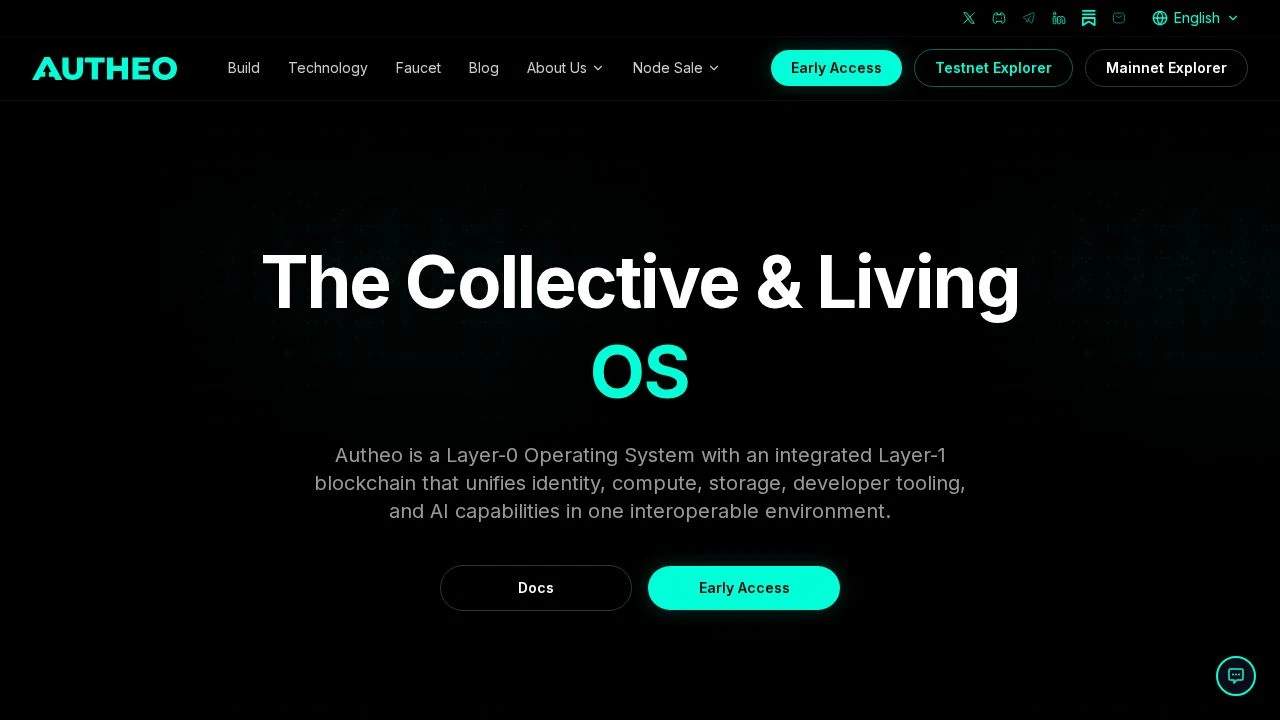
Autheo | The Collective & Living OS
Autheo is a Layer-0 Operating System with an integrated Layer-1 blockchain that unifies identity, compute, storage, developer tooling, and AI capabilities in one interoperable environment.
The foundation for the connected, intelligent web.
Autheo is a Layer-0 Operating System with an integrated Layer-1 blockchain that unifies identity, compute, storage, developer tooling, and AI capabilities in one interoperable environment.
Follow Autheo: X (Twitter) · LinkedIn
Use Cases
- Building and testing blockchain applications on the Chain ID 21270 testnet using the EVM and Cosmos explorers, faucet, and SDKs
- Routing and reporting on AI agent commerce across payment rails such as x402, AP2, ACP, and UCP, with agent identity and reputation tracking
- Running a validator node and staking THEO to help secure the Autheo network and earn rewards
Who it is for
- Developers building on Autheo's Layer-1 and Layer-0 stack, using its SDKs, RPC, and testnet tooling
- Teams building agentic commerce systems that need agent identity, payment rails, and audit reporting
- Node operators and token holders who run validators or stake THEO
Pricing
THEO is traded on Uniswap, Hydrex, and MEXC, and staking is offered on Robinhood Chain.
FAQ
What is Autheo?
Autheo is a Layer-0 Operating System with an integrated Layer-1 blockchain, built to unify the infrastructure that Web3 applications normally have to stitch together from separate vendors. Mainnet is live today with staking and transaction fees operating on-chain, and the DevHub developer workspace is available now; sovereign identity (TheoID), decentralized compute and persistent storage through the Autheo Marketplace, AI inference (THEO AI), and post-quantum cryptography are rolling out on mainnet over the coming months. The goal is to let builders focus on product logic instead of integrating IPFS, Chainlink, The Graph, wallet providers, and cloud compute by hand. Autheo develops the platform with the Autheo Foundation, which stewards the community and open-source work.
What can I build on Autheo?
Autheo is EVM-compatible, so any Solidity smart contract that runs on Ethereum, Polygon, or other EVM chains can be deployed on Autheo using standard tools like Hardhat and Foundry. Beyond smart contracts, the DevHub is rolling out native platform services designed as first-class primitives: decentralized compute through the Autheo Marketplace for off-chain workloads, sovereign identity (TheoID) for authentication and digital asset ownership, persistent storage through the Autheo Marketplace for data durability, and AI inference (THEO AI) for model calls, coming online on mainnet over the coming months. Typical applications include DeFi protocols, decentralized AI services, identity-gated content and commerce, tokenized real-world asset platforms, and agentic applications that need both on-chain settlement and off-chain compute. The goal is for teams to ship faster than they would integrating five separate third-party stacks.
What is the THEO coin used for?
THEO is the native utility coin of the Autheo network. Staking for validator nodes and transaction fees on the Layer-1 are live today, and THEO is designed to also pay for decentralized compute and storage through the Autheo Marketplace, and AI inference as those layers roll out on mainnet over the coming months. Validators earn THEO emissions over a seven-year schedule for helping secure the network, and developers will spend THEO inside the DevHub to access metered platform services as they come online. THEO is explicitly a utility coin and not a governance token, because Autheo and the Autheo Foundation steward the platform rather than operating as a DAO with on-chain voting.
How is Autheo different from Ethereum or Solana?
Ethereum and Solana are Layer-1 blockchains focused on consensus, settlement, and smart contract execution. Anything else an application needs (identity, storage, compute, AI, developer tooling) has to be assembled from outside services like IPFS, Arweave, Chainlink, The Graph, or wallet providers. Autheo is a Layer-0 Operating System with an integrated Layer-1, so TheoID, decentralized compute and storage through the Autheo Marketplace, and THEO AI are designed as native components rather than external dependencies, with the DevHub live today and the rest rolling out on mainnet over the coming months. Autheo is also building post-quantum cryptography (Kyber, Dilithium, Falcon) as a first-class primitive at the identity and key-material layer, planned as a differentiator neither Ethereum nor Solana provides natively; it is not yet threaded into the live system. For teams, the goal is fewer vendors to integrate and one consistent identity and data model across the entire stack.
What trilemma does Autheo solve?
Autheo addresses the blockchain trilemma (the long-standing trade-off between decentralization, security, and scalability) from the perspective of an operating system rather than a single chain. Decentralization is preserved through the live validator node network, with sovereign TheoID rolling out to extend that so identity and participation are not controlled by any single issuer. Security is designed to be reinforced by post-quantum cryptography (Kyber, Dilithium, Falcon) at the identity and key-material layer, planned to protect assets against both classical and anticipated quantum attacks as it rolls out on mainnet; it is not yet threaded into the live system today. Scalability is pursued by moving identity, compute, storage, and AI workloads off the execution chain onto purpose-built Layer-0 components as those components come online, so the Layer-1 is not forced to serve as the universal bottleneck. Quantified performance figures will be published after independent third-party b
Is Autheo live?
Yes. Autheo mainnet went live on May 14, 2026, with staking and transaction fees operating on-chain today. Developers can build now through DevHub, which wires up the SDKs and documentation in one place. Additional platform layers, including TheoID, decentralized compute and persistent storage through the Autheo Marketplace, AI inference (THEO AI), and post-quantum cryptography, are rolling out on mainnet over the coming months.
Alternatives
 AuthexFor IT teams: Authex automatically configures email authentication and DNS so your domain stays secure and mail stays deliverable.
More in Developer Tools
New on Launch Llama
Launched this week · This month's launches · All products A–Z
Ask AI about Autheo
Supporters
1 founder
1 founder supported Autheo on Launch Llama.
For bots & AI agents
Machine-readable versions of Autheo and Launch Llama. Fetch these instead of parsing this page.
This listing (.md) llms.txt llms-full.txt ai.txt Full catalog (.md) Endpoint index API docs MCP server MCP manifest Developer docs