


Verdict
Live coaching that treats the interview and the English as the same problem, with a free trial before you buy a pack.
For Software, product, and data people interviewing in English who already know the material and lose it once they have to say it out loud.
Pros
- Coaches are working engineers, so the feedback is on the interview, not a grammar worksheet.
- One session covers the format you actually have: HR, behavioural, live coding, or system design.
- The 30-minute trial is free, so you can check the coach before you buy a pack.
- You leave with written feedback, and you can message your coach on Telegram between sessions.
Cons
- A session costs $42.50 to $50. A guide or an AI speech app is cheaper.
- You are booking a person. Time zones and calendars decide when you can practise.
- It sharpens how you explain the work. It does not teach the algorithms or the system design.
- If you cannot hold a conversation in English yet, a session is the wrong first step.
Most English apps help you order coffee. Most interview coaches ignore language. Non-native speakers interviewing for Amazon, JetBrains, Nebius, or remote EU/US roles need both: clear English under pressure, and answers that sound like a senior engineer, not a textbook.
That is the gap Mockly English is built for.
What Mockly English actually is
Mockly English is a live coaching product for tech professionals who interview in English. You book Google Meet sessions with coaches who are both native British English speakers and working engineers. The point is not general conversation practice. It is HR screens, behavioural stories, coding explanations, and system design, with feedback on your answers and your language in the same session.
The product page positions it clearly: English interview preparation for tech professionals. Coaches cover clarifying questions, STAR-style behavioural answers, live corrections during the call, and written feedback after. Between sessions you can stay in touch on Telegram.
The interview course
The homepage says the sessions cover an HR screen, a behavioural round, live coding, and system design. The thing you study between those calls is the interview course. I opened the public version on 26 September 2026. It is seven modules and 62 lessons. The names are not the four rounds. They are Before the interview (6), Self introduction (9), Strengths and weaknesses (9), Behavioural (9), Motivation and goals (10), Technical (14), and Interview culture (5).
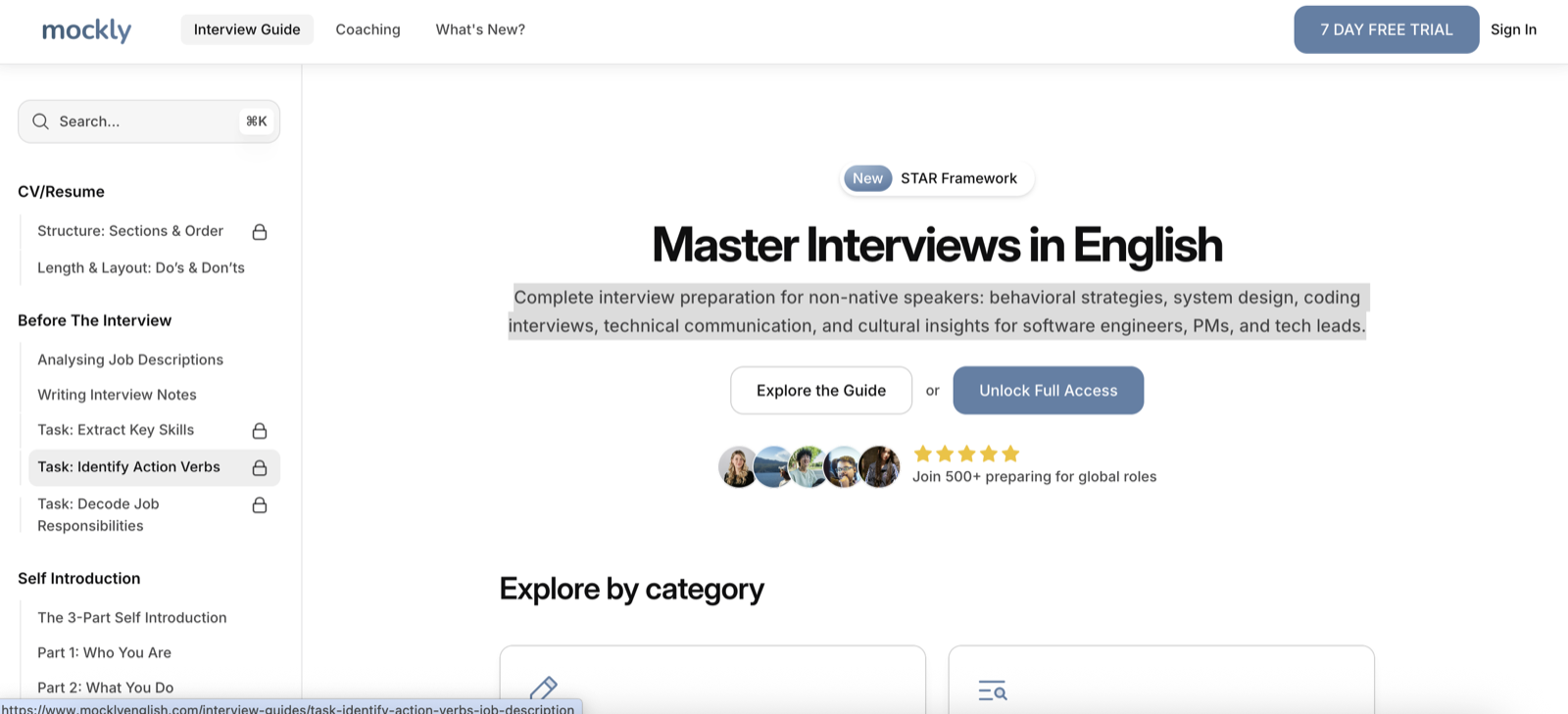
There is no module called HR screen. The homepage list for that round, CV, self introduction, motivation, long-term goals, is spread across Self introduction, Motivation and goals, and a separate CV guide. The self-introduction lesson is a real script, and it is free. Four parts, a software-engineer model answer, and a product-manager variant. The lesson itself says the whole answer is 1 to 3 minutes. The page title and the FAQ on the same page say 60 to 90 seconds.
Behavioural is the strongest module. The STAR lesson is free. It gives the split it wants you to hit: situation 10 percent, task 10 percent, action 60 percent, result 20 percent, and it tells you to say I, not we. There are three full examples: a production bug, a disagreement with a product lead, and a database migration. Then the page disagrees with itself. The title says aim for 90 seconds to two minutes. The lesson says a behavioural answer is usually two to four minutes.
Technical is where live coding and system design are supposed to live. The opening lesson is marked premium, and it says those formats exist, then says the module will not prepare you for each of them. It covers three skills: clarify the problem, think out loud, and respond to feedback.
System design is lesson 7, Build: Design a chat app, also premium. It does not ask you to design the app. It asks for 3 to 5 clarification questions about WhatsApp or Telegram, each in a box of 200 characters. Architecture is a bullet under topics to consider. You never draw a box.
Live coding is lesson 10. The public title is How to Explain a LeetCode Solution in English, and the FAQ tells you to state time and space complexity. The exercise on that page is detect duplicate records in a customer database. Four boxes: initial idea, trade-offs, justify, next steps. It says write bullets, not sentences. Complexity is not one of the boxes.
So the course is a curriculum for the spoken parts of an HR screen and a behavioural round. It is not a system-design course or a live-coding course. Those two rounds are communication drills inside one module. That is the same limit as the score. It sharpens how you explain the work. It does not teach the algorithms or the design. Every module has free lessons. The two builds above are marked premium. I did not create an account, so I did not test what the lock actually hides.
Coaches and format
Published coaches include Sophie F. (data engineer and English coach) and Tom O. (software engineer and ESL instructor). Both list British English, mathematics backgrounds, and thousands of lessons taught. Public reviews on the site cite offers at international companies, stronger behavioural answers, and better confidence in system design and STAR stories.
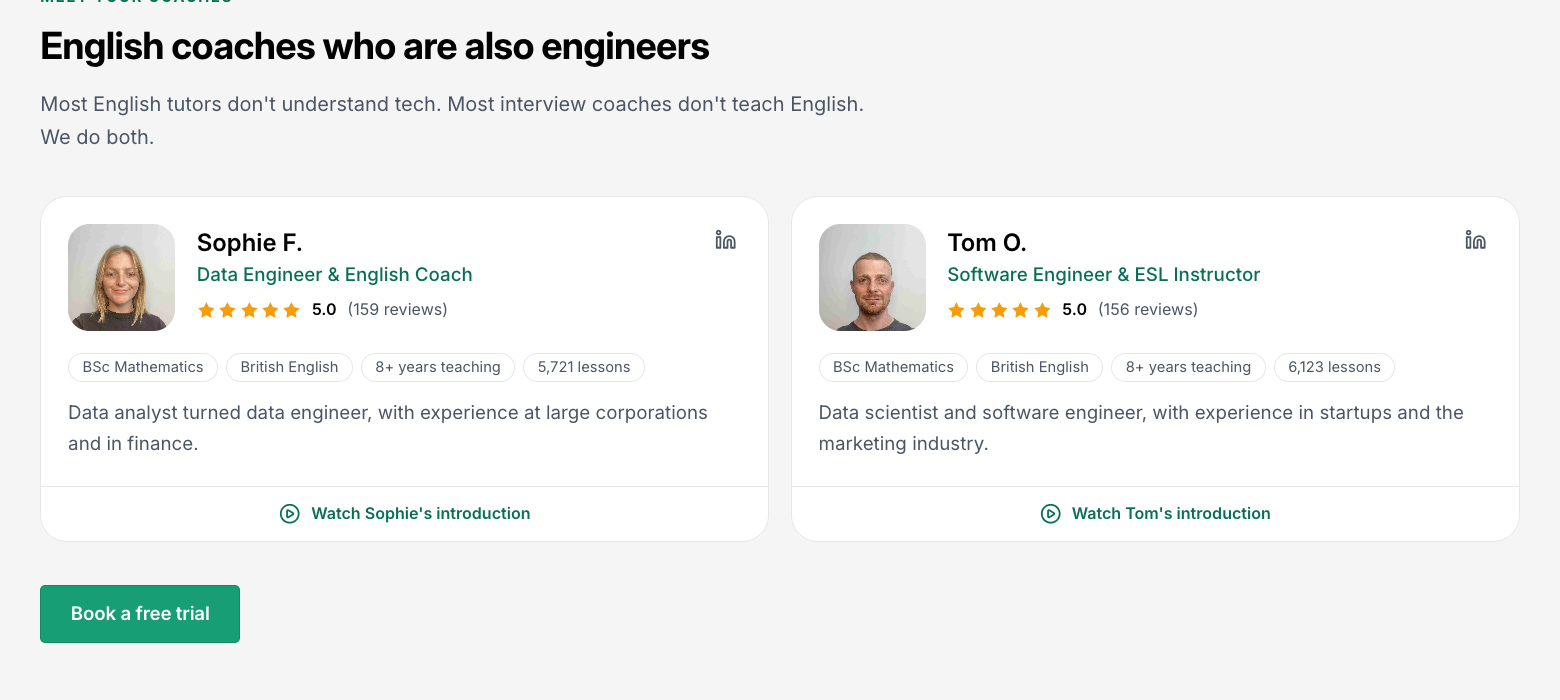
A paid session is 60 minutes on Google Meet: personalised focus for your role, live corrections, written feedback, and prep using Mockly course materials. The free trial is 30 minutes: roles and companies, English level check, and a plan. That is the right order. Do not buy a 20-pack before you know the coach fit.
Pricing
Trial is free. After that, Mockly sells session credits valid for 12 months. There is no subscription.
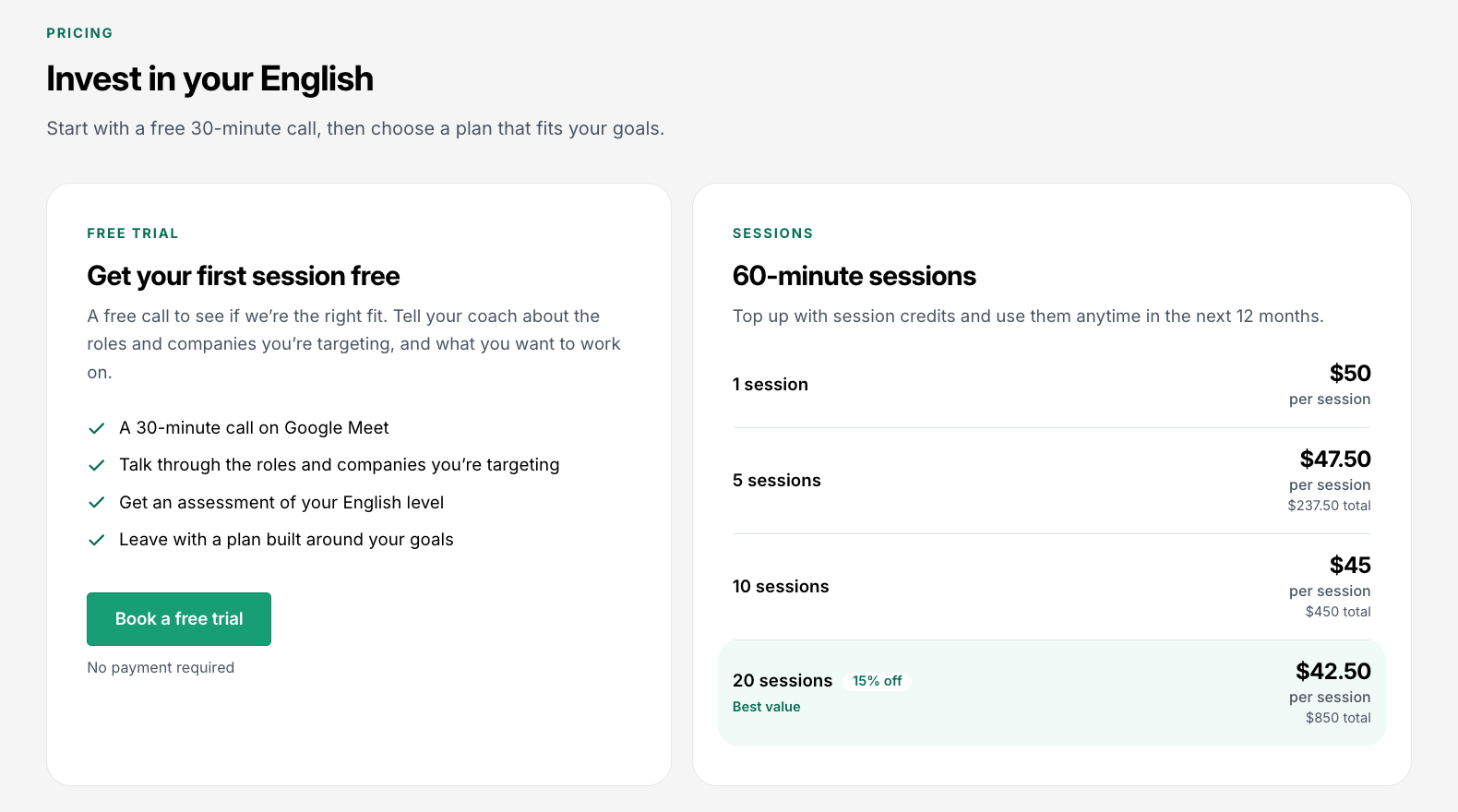
| Pack | Per session | Pack price | When it fits |
|---|---|---|---|
| 1 session | $50 | $50 | Check the coach fit |
| 5 sessions | $47.50 | $237.50 | Enough for one or two loops |
| 10 sessions | $45 | $450 | A longer search |
| 20 sessions | $42.50 | $850 | Best value on the page |
For one or two loops, the 5-pack at $237.50 is the sensible buy. The 20-pack at $850 only makes sense if you are running a long search across multiple companies and want the same coach for months. Current prices are on their site. Treat the numbers here as a snapshot.
Who this is actually for
A fit
The software, product, or data person who already knows the material and loses it once the loop is in English. HR screen, behavioural round, live coding narration, system design. A 5-pack is a few hours against freezing in the round that decides the offer. It also fits someone a few weeks out, before the calendar fills up. The trial is 30 minutes: roles, level, and a plan. Start there.
Start somewhere else
Someone who wants a PDF to read on the train, or whose only problem is individual sounds. A pronunciation app first, then Mockly, is the cheaper order. It also does not fit a candidate who cannot hold a conversation in English yet. The coaches correct language inside an interview. They are not a beginner course.
Where it falls short
You are paying for an hour with a person.
$42.50 to $50 a session is the price of a working engineer on a call. An eBook or an AI speech app will always look cheaper, because it is not the same thing. If the budget for interview prep is a book, this is the wrong product, and the pricing table above is the whole argument.
The calendar is not yours.
Sessions are Google Meet with named coaches. If you are in a US evening and they are in a UK morning, the slots shrink. A self-paced guide does not have that problem. Live coaching does, and the free trial is where you find out whether the times actually work before you buy a pack.
It sharpens delivery of work you already know.
Clarifying questions, STAR stories, coding explanations, system design. If the gap is that you cannot solve the problem, another session will not fix it. Pair the calls with the study. Do not substitute the calls for it. The useful version of this product is a coach on top of LeetCode and system-design practice, not instead of them.
Baseline English still sets the ceiling.
Public reviews on the site talk about offers, stronger behavioural answers, and more confidence in system design. Those are candidates who could already hold the conversation. If you cannot, start with lower-stakes practice and come back when the interview is the hard part, not the sentence.
Alternatives worth a look
| Tool | Use it when |
|---|---|
| Speak Tech English | You want structure between calls. The calls are where you find out whether you can say it. |
| Yoodli | You want AI speech practice, with no engineer on the other side. |
| ELSA | The gap is sounds, not stories. |
| A general English tutor | You want cheaper conversation. The hour will not be an Amazon loop. |
For a wider shortlist, see our ranking of interview prep platforms for non-native English speakers, where Mockly sits alongside Speak Tech English, Yoodli, and ELSA.
Should you use it?
If you have loops coming up in English and the material is already in your head, book the free trial. If the coach fit is real, buy the 5-pack. Keep a self-paced guide only if you want homework between calls.
If you are still building the fundamentals, or you only need a PDF, spend the money later.
The 4.0 is for coaches who know the formats, a trial you do not pay for, and a price you can read before you book. The missing point is the thing a live session cannot do. It will not study for you, and you can only practise when a coach is free.
Visit Mockly English