
NameScore
For founders and agencies: NameScore validates brand names for strength, distinctiveness, and market readiness before launch investment.
Built by Henning · Productivity · Marketing · Freemium
In category: #424 of 1429 · Productivity
NameScore is an Instant Launch listing on Launch Llama with 35 total upvotes, founded by Henning who joined in Apr 2026, compared against 5 alternatives.
Instant Launch listing
Listing status
35upvotes
Community score
Henning (Joined Apr 2026)
Founder
Compared against 5 alternatives
Market comparison
Launched on Launch Llama Apr 7, 2026 · #2 of 5 that day
About
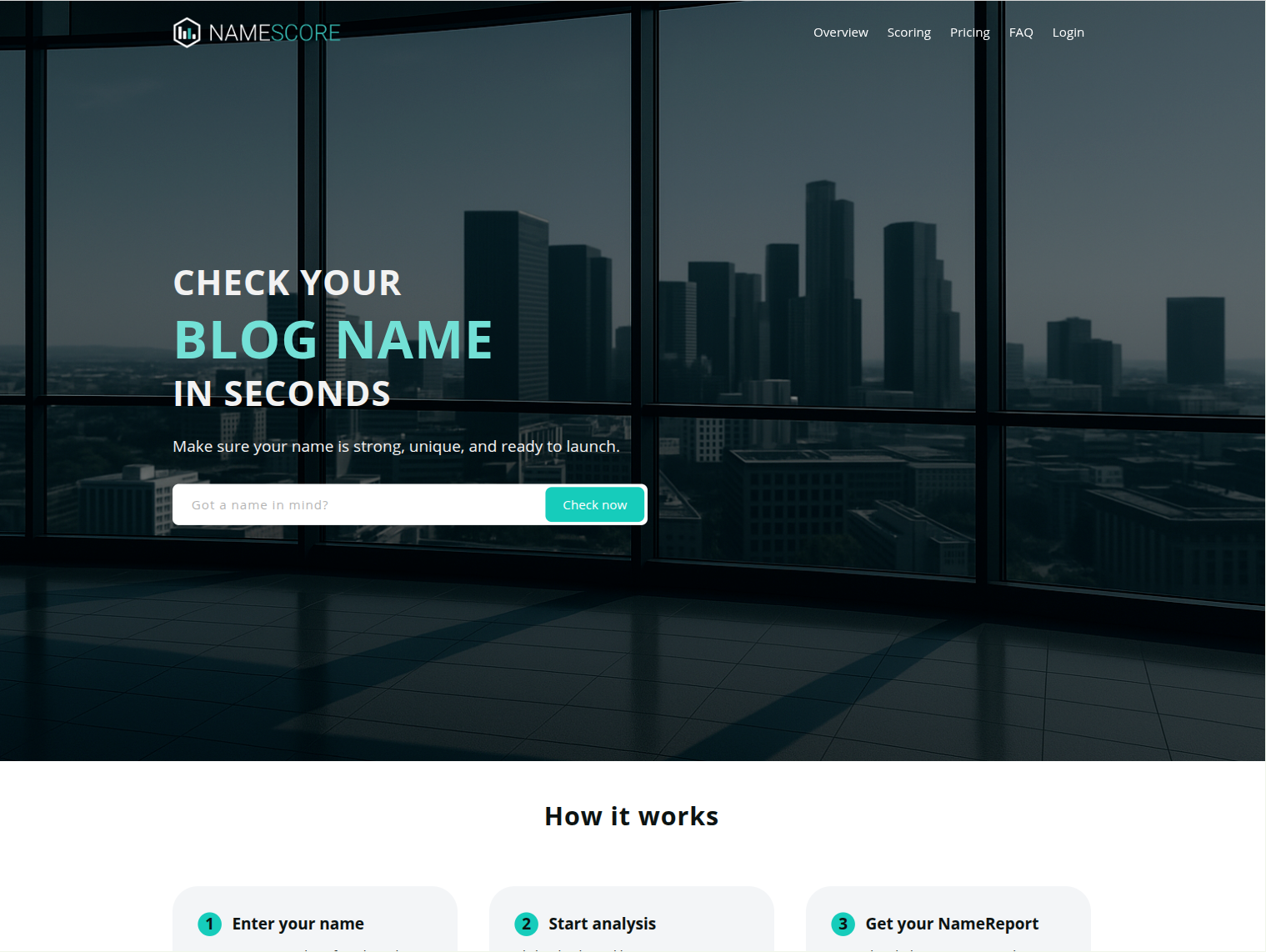
NameScore is a brand name intelligence tool: it helps founders, startups, and agencies validate whether a name is strong, distinctive, and launch-ready before they invest in branding, domains, or go-to-market.
A great name is like a great book title: it makes people want to look inside.
NameScore helps you find out whether your name has that kind of pull, while also checking if it’s unique, memorable, available, and safe to build on.
Use Cases
- Checking a startup or brand name for trademark conflicts before investing in launch branding
- Confirming whether matching domains and social media handles are available before committing to a company name
- Comparing candidate business names on strength, uniqueness, and how they sound before choosing one
Who it is for
- Startup founders choosing a name for a new brand or product
- Branding and naming agencies validating names for clients
- Indie hackers and solo developers picking a domain-ready product name
Pricing
Each NameReport is a one-time payment with no subscription, normally $50 and currently $10 for a first report.
NameScore at a glance
- 01What it is
- NameScore: For founders and agencies: NameScore validates brand names for strength, distinctiveness, and market readiness before launch investment.
- 02Pricing
- NameScore pricing: Each NameReport is a one-time payment with no subscription, normally $50 and currently $10 for a first report.
- 03Best for
- NameScore is best for startup founders choosing a name for a new brand or product, branding and naming agencies validating names for clients and indie hackers and solo developers picking a domain-ready product name.
- 04Alternatives
- Top NameScore alternatives on Launch Llama: knowris, NameSpyAI and AIBranding.
FAQ
What is NameScore?
<div class="quiqqer-faqAccordion-item-content-pageShort text-muted">NameScore is the leading online tool for comprehensive brand, company, and product name evaluation - trusted by founders, startups, agencies, and product developers worldwide. </div><div class="quiqqer-faqAccordion-item-content-pageContent"><p>In seconds, our AI-powered service analyzes your name idea across critical criteria, including:Trademark safety (real checks in international databases)</p> <ul> <li>Domain availability</li> <li>Social media handles</li> <li>Search engine & App Store visibility</li> <li>Linguistic risks and hidden meanings</li> <li>Sound, style, and emotional impact</li> <li>Length, structure, and memorability</li> </ul> <p>You get a detailed, multi-page NameReport PDF with clear explanations, an overall NameScore, and actionable recommendations.</p> <p>Avoid costly naming mistakes, save hours of manual research, and make confident decisions - all with a simple one-time payment (no subscripti
What is the NameScore Report?
<div class="quiqqer-faqAccordion-item-content-pageShort text-muted">The NameScore Report is a professional, multi-page PDF that delivers a complete, easy-to-understand breakdown of your name analysis - helping founders, startups, and agencies make smarter naming decisions with confidence.</div><div class="quiqqer-faqAccordion-item-content-pageContent"><p>Inside your personalized report, you'll find:</p> <ul> <li>Detailed scores and explanations for every check, highlighting strengths (e.g., strong trademark safety or memorable sound) and potential risks (e.g., linguistic pitfalls or low domain availability)</li> <li>Overall NameScore with actionable recommendations</li> <li>In-depth insights into trademark status, domain & social handle availability, search engine/App Store visibility, linguistic risks, phonetic style & emotional impact, length, and more</li> </ul> <p>Reports can vary in depth depending on the selected checks, but every one is designed for clarity and immed
Which aspects does NameScore evaluate?
<div class="quiqqer-faqAccordion-item-content-pageShort text-muted">NameScore delivers the most comprehensive name evaluation available - combining real trademark data, marketing viability, linguistic analysis, and aesthetic scoring to help you choose a safe, memorable, and market-ready brand name.</div><div class="quiqqer-faqAccordion-item-content-pageContent"><p>Our AI-powered checks cover legal, marketing, and creative dimensions, including:</p> <ul> <li>Trademark safety - Real-time search in international trademark databases: Is your name (or something confusingly similar) already registered?</li> <li>Domain availability - Checks popular top-level domains (.com, .io, .co, etc.) and suggests strong alternatives.</li> <li>Search engine & App Store visibility - How crowded is your name in Google, Bing, Apple App Store, and Google Play?</li> <li>Social media handles - Availability across major platforms like Instagram, Twitter/X, TikTok, LinkedIn, Facebook, and more.</li> <li>Lingu
What is the NameScore Expert Opinion?
The NameScore Expert Opinion is an AI-powered feature that delivers unbiased, professional assessments from virtual naming experts - giving you fresh, outside perspectives to refine your branding decisions. Perfect when you're torn between options or need deeper validation, these insights often uncover surprising strengths, hidden weaknesses, or creative angles you might have missed. Key evaluations include: Overall impression and emotional impact Name type (e.g., descriptive, invented, evocative) Associative potential and storytelling power Memorability, distinctiveness, and standout factor Expandability for future growth (e.g., product lines, international markets) Future-proofing and long-term viability Precise fit with your target audience How it works: Our virtual experts draw from diverse fields like marketing, linguistics, phonetics, and cultural studies. Plus, you get tailored feedback from simulated representatives of your specific target audience. It's the ideal creative comp
How can I check if a brand name is already trademarked?
Checking whether a brand name is already protected as a trademark is one of the most important steps in naming - a conflicting trademark can lead to costly legal disputes or forced rebranding. Manual options (free but time-intensive): Search national trademark offices (e.g., USPTO in the US, EUIPO for the EU, or equivalent registries in other countries). Use global search tools like WIPO’s Global Brand Database or TMview to scan multiple jurisdictions. For thorough protection, consider hiring a trademark attorney to perform a comprehensive search, including common law (unregistered) rights. These manual searches require expertise to interpret results, often miss similar (not identical) marks, and don’t cover marketing aspects like domain or social media availability. The faster, more complete way: NameScore automates real-time trademark checks across major international databases, flags exact matches and phonetically/confusingly similar marks, and combines this with domain,
How do I check if a company or business name is already taken?
Finding out if your desired company or business name is already in use is essential to avoid legal conflicts, registration rejections, or confusion in the market. Traditional ways to check (free but limited): Search national company registries (e.g., Companies House in the UK, Secretary of State websites in the US, Handelsregister in Germany, or equivalent registries in your country). Look for active businesses with the same or similar names via official government databases. Check for domain names and social media handles manually to gauge real-world usage. These checks are often jurisdiction-specific, time-consuming, and don’t reveal unregistered (common law) usage or similar names that could still cause issues. The smarter, global approach: NameScore automates company name availability insights by cross-referencing major registries, detecting similar existing businesses, and combining this with trademark status, domain & social media availability, search engine competition, an
When does a name become legally protected as a trademark?
A name (or logo, slogan, etc.) becomes legally protected as a trademark in two main ways, depending on the country or region. 1. Through official registration The strongest and most reliable protection comes from registering the mark with a national or regional trademark office (e.g., USPTO in the USA, EUIPO for the European Union, or equivalent authorities worldwide). Once approved and registered, you gain exclusive rights in the specified categories and territories - typically lasting 10 years and renewable indefinitely. 2. Through actual use in commerce (common law rights) In some countries (especially the US and UK-influenced systems), simply using the name in trade can create limited "common law" rights - even without registration. However, these rights are harder to prove and enforce, and usually only apply locally where the name is actively used. Important: Protection is almost always limited to specific goods/services classes and geographic regions. A name can be registered by
What is a trademark register, and how does it work?
A trademark register is an official public database maintained by a national or regional trademark office that lists all registered trademarks (brand names, logos, slogans, etc.) along with their owners, classes of goods/services, registration dates, and status. Key examples of major registers: USPTO (United States Patent and Trademark Office) - for the US EUIPO (European Union Intellectual Property Office) - covers all 27 EU countries WIPO (World Intellectual Property Organization) - administers international registrations via the Madrid System National offices in the UK, Canada, China, India, Australia, etc. How it works: A company or individual applies to register a mark in specific classes and territories. The office examines the application for distinctiveness, conflicts with existing marks, and compliance with rules. If approved (often after months or years), the mark is entered into the public register, granting exclusive rights in those classes and regions. Anyone can search th
How can I find out if a company with my desired name already exists?
Discovering whether a company with your desired name is already registered is a key early step - it helps avoid registration denials, legal challenges, or market confusion. Common ways to check manually (free but fragmented): Search official national company registries (e.g., Companies House in the UK, state-level Secretary of State databases in the US, the commercial register in Germany/Switzerland/Austria, or equivalent government portals in your country). Use global business directories or credit agencies for additional clues. Google the exact name + “LLC”, “GmbH”, “Ltd”, etc., and check domain/social media usage for active businesses. These searches are usually limited to one jurisdiction, miss inactive or recently dissolved companies, and don’t reveal similar names that could still cause issues. The faster and broader solution: NameScore automatically scans major company registries worldwide, flags exact and similar existing businesses, an
Can the same company or brand name be registered twice?
Yes - but it depends on context, jurisdiction, industry, and territory. The same name can often coexist without conflict under certain conditions: For company names (business registrations): Many countries allow identical or very similar company names if they operate in different regions (e.g., one in California, another in New York) or different industries. Some registries require uniqueness only within the same state/province or nationally, while others are more lenient. However, even if registration is approved, an existing company with common law rights or a trademark could still challenge you. For trademarks (brand protection): The same name can be registered by different owners in unrelated goods/service classes (e.g., “Delta” for airlines and “Delta” for faucets). Identical trademarks in the same class are generally not allowed if they cover the same territory. Geographic separation also permits duplicates (e.g., one trademark in the US, another in Japan)
Alternatives
 knowrisFor founders: knowris generates distinctive brand names using linguistic science and domain checking so you launch with a memorable, available identity.
 NameSpyAIFor founders: NameSpyAI checks trademarks, domains, and social handles across 15+ platforms so you launch a product name without legal risk.
 Startup.Ready.For early-stage founders: Startup.Ready. diagnoses readiness gaps across six pillars—founder, problem, market, model, go-to-market, financials—then routes you to priority work.
More in Productivity
New on Launch Llama
Launched this week · This month's launches · All products A–Z
Ask AI about NameScore
Supporters
2 founders
2 founders supported NameScore on Launch Llama.

For bots & AI agents
Machine-readable versions of NameScore and Launch Llama. Fetch these instead of parsing this page.
This listing (.md) llms.txt llms-full.txt ai.txt Full catalog (.md) Endpoint index API docs MCP server MCP manifest Developer docs