On Launch Llama
Spanlens - Open-source LLM observability platform
For developers: Spanlens logs every LLM API call with cost, latency, and tokens so you optimize spend and catch performance issues instantly.
Built by HAESEONG JEON
Free
Visit website → Upvotes · 2
Spanlens is a Instant Launch listing on Launch Llama with 2 total upvotes across 1 founder supporter, founded by HAESEONG JEON who joined in Jul 2026, compared against 6 alternatives.
Instant Launch listing
Listing status
2upvotes
Community score
HAESEONG JEON (Joined Jul 2026)
Founder
Compared against 6 alternatives
Market comparison
About
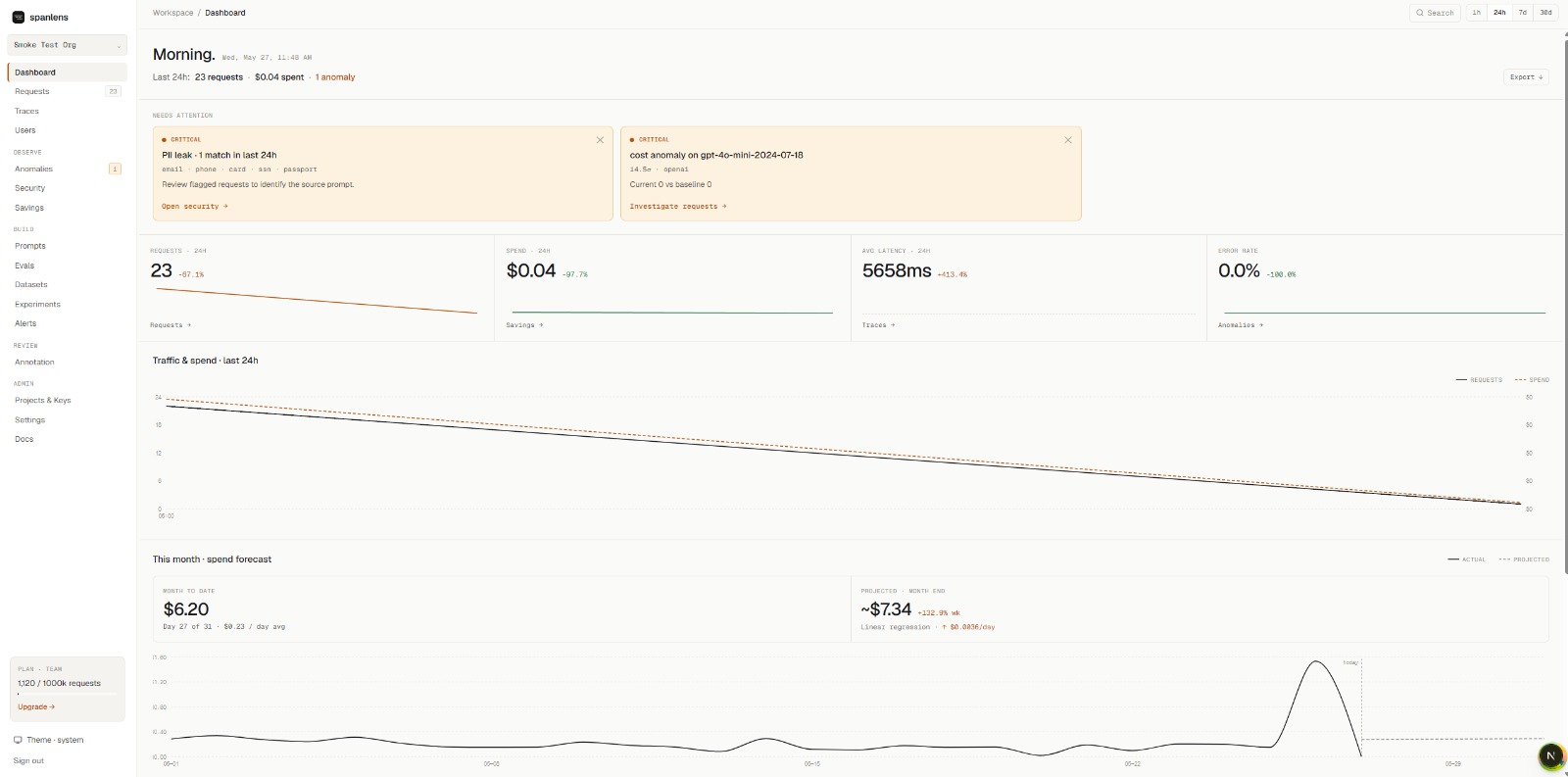
Spanlens is an open-source (MIT) LLM observability platform that lets developers monitor every call their application makes to OpenAI, Anthropic, Gemini, Mistral, OpenRouter, Azure OpenAI, or a local Ollama model. Integration takes one line: swap your client's baseURL to the Spanlens proxy, or run "npx @spanlens/cli init" and the wizard rewrites your code automatically. From that moment, every request is recorded with its model, token counts, latency, cost, and full prompt and response body, with streaming responses reconstructed automatically. The dashboard turns that raw log into operational insight. Cost tracking breaks spend down per request, per model, and per end user, and parses prompt-cache tokens separately so you see real cache savings rather than sticker price. Agent tracing visualizes multi-step workflows as Gantt waterfalls and node-and-edge graphs, highlighting the critical path so you can find the slowest dependency chain in a fan-out. Anomaly detection flags 3-sigma deviations in latency, cost, or error rate against a rolling 7-day baseline with root-cause hints. Alerts on budget, error rate, and p95 latency are delivered to Email, Slack, or Discord. Spanlens goes beyond passive logging. A regex-based PII and prompt-injection scanner inspects request and response bodies and can block injections at the proxy. The savings engine spots calls that match a cheaper model's profile (for example, a gpt-4o call that looks like a classification task) and estimates the monthly saving from switching. Prompt versioning with A/B experiments compares versions on latency, cost, and error rate using Welch's t-test for statistical significance, and an LLM-as-judge evaluation framework (judge with OpenAI, Anthropic, or Gemini) scores outputs against rubric anchors, with human agreement measured by Pearson r or Cohen's kappa. Reusable datasets power offline evals and regression checks.
Ask AI
ChatGPT Claude Perplexity Grok
For agents
llms.txt · llms-full.txt · ai.txt · Live fact sheet · Full catalog (.md) · Endpoint index · API spec · REST access · Agent server · Server manifest · Server discovery
Pricing
Spanlens is free to use. See the website for details.
FAQ
What is Spanlens?
Spanlens is an open-source (MIT) LLM observability platform that lets developers monitor every call their application makes to OpenAI, Anthropic, Gemini, Mistral, OpenRouter, Azure OpenAI, or a local Ollama model. Integration takes one line: swap your client's baseURL to the Spanlens proxy, or run "npx @spanlens/cli init" and the wizard rewrites your code automatically. From that moment, every request is recorded with its model, token counts, latency, cost, and full prompt and response body, with streaming responses reconstructed automatically. The dashboard turns that raw log into operational insight. Cost tracking breaks spend down per request, per model, and per end user, and parses prompt-cache tokens separately so you see real cache savings rather than sticker price. Agent tracing visualizes multi-step workflows as Gantt waterfalls and node-and-edge graphs, highlighting the critical path so you can find the slowest dependency chain in a fan-out. Anomaly detection flags 3-sigma deviations in latency, cost, or error rate against a rolling 7-day baseline with root-cause hints. Alerts on budget, error rate, and p95 latency are delivered to Email, Slack, or Discord. Spanlens goes beyond passive logging. A regex-based PII and prompt-injection scanner inspects request and response bodies and can block injections at the proxy. The savings engine spots calls that match a cheaper model's profile (for example, a gpt-4o call that looks like a classification task) and estimates the monthly saving from switching. Prompt versioning with A/B experiments compares versions on latency, cost, and error rate using Welch's t-test for statistical significance, and an LLM-as-judge evaluation framework (judge with OpenAI, Anthropic, or Gemini) scores outputs against rubric anchors, with human agreement measured by Pearson r or Cohen's kappa. Reusable datasets power offline evals and regression checks.
How much does Spanlens cost?
Spanlens is free to use. See the website for details. You can discover and review Spanlens for free on Launch Llama.
How do I get started with Spanlens?
Click the "Visit Website" button on this page to go directly to Spanlens. You can also upvote and leave a review to help other founders discover it.
Supporters
1 founder1 founder contributed 2 upvotes to Spanlens on Launch Llama.
Reviews
1 comment
Hey, love seeing this here! 👋 What inspired you to build this? Would love to hear the story behind it.
Alternatives
- AI Observability by OpenObserve
For AI teams: OpenObserve monitors LLM agents with 140x lower storage costs than competitors so you debug production issues without breaking budgets.
- Future AGI
For AI engineers: traceAI captures prompts, completions, and agent decisions across 35+ frameworks, routing to your existing observability stack in two lines of code.
- OfoxAI
For developers: OfoxAI gives you one API key to access 100+ LLMs through a single OpenAI-compatible endpoint so you stop juggling multiple provider accounts.
- ModelRouter
For AI developers: ModelRouter routes requests across GPT, Claude, and Gemini through one API so you compare performance and costs before scaling.
- Userlens
For SaaS teams: Userlens identifies lagging users and sends personalized adoption nudges so features get adopted faster.
- ClawMetry
For developers: ClawMetry provides full observability inside NemoClaw sandboxes, tracking thoughts, tool calls, and token costs in real time.