
HyperLake
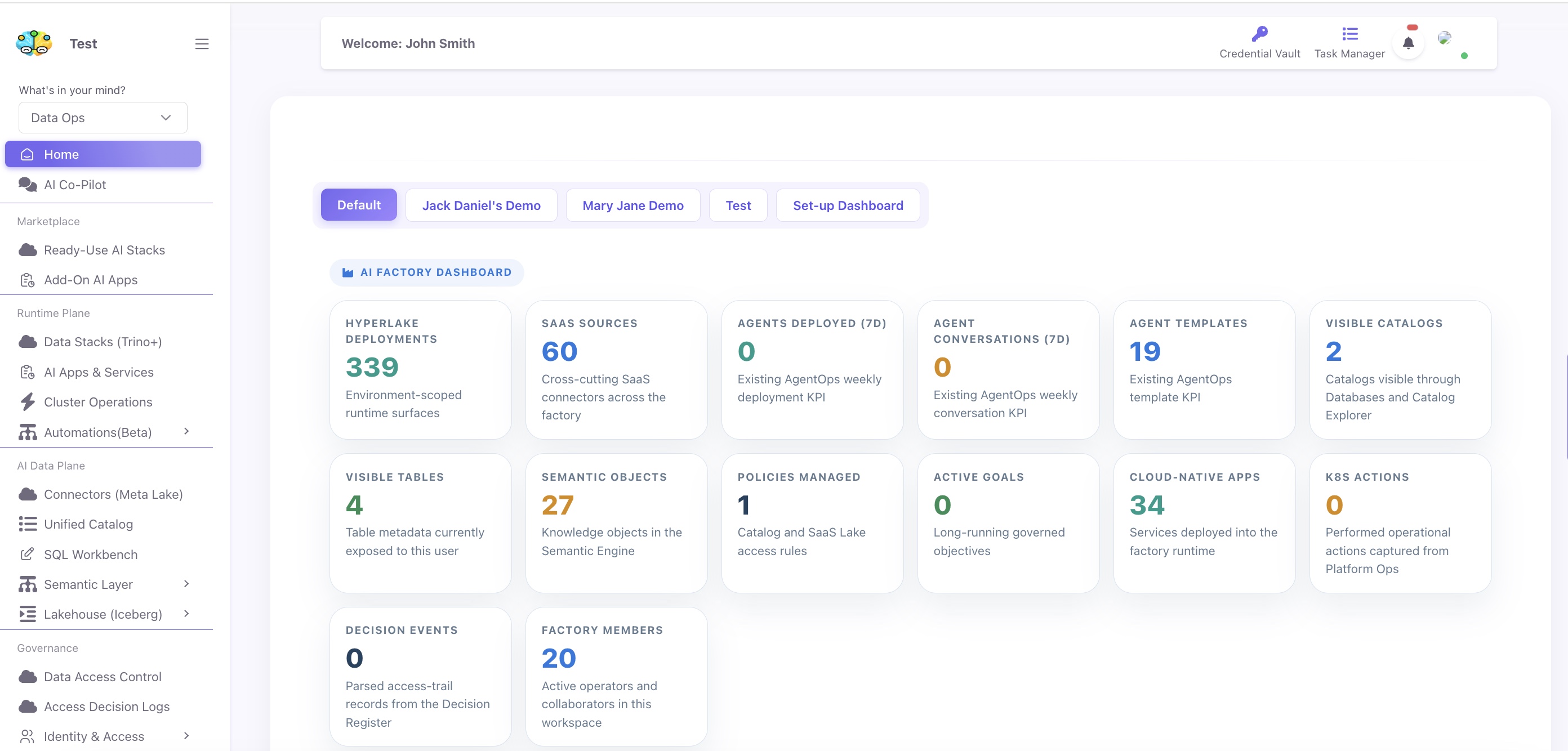
For enterprises: HyperLake manages sovereign AI agent infrastructure across your VPC—deploy, secure, and govern data, workflows, and agents in-house.
Built by CerebrixOS · Artificial Intelligence · Paid
In category: #1223 of 2052 · Artificial Intelligence
HyperLake is a Community listing on Launch Llama with 7 total upvotes, founded by CerebrixOS who joined in May 2026, compared against 4 alternatives.
Community listing
Listing status
7upvotes
Community score
CerebrixOS (Joined May 2026)
Founder
Compared against 4 alternatives
Market comparison
Launched on Launch Llama May 23, 2026 · #11 of 25 that day
About
HyperLake is built for organizations preparing for a world where AI agents become primary users of infrastructure.
Today, most enterprise infrastructure was designed for humans, dashboards, applications, and scheduled pipelines. AI agents behave differently. They query data, call tools, trigger workflows, generate artifacts, operate across systems, and need continuous access to governed compute, data, policies, and services.
HyperLake provides the command center to deploy, manage, run, secure, and govern that agentic infrastructure. The first product wedge is Agentic Data Cloud Infrastructure: open-stack data, analytics, semantic, workflow, and agent infrastructure deployed inside the customer’s own VPC, private cloud, or on-prem environment.
But the broader vision is larger than one stack. HyperLake is designed to manage many agentic infrastructure stacks: HyperLake-native stacks, customer-owned cloud services, AWS/GCP/Azure-native components, open-source technologies, governed data services, workflow systems, MCP tools, and future production-ready agentic use cases.
The goal is to make agentic infrastructure usable, secure, and production-ready end to end. Enterprises should be able to choose the stack, deploy it where their data lives, govern every human and agent interaction, audit every action, and scale new AI use cases without rebuilding the operating layer each time.
Follow HyperLake: X (Twitter) · LinkedIn
Use Cases
- Deploy a private model endpoint with governed access to your own asset data inside your VPC
- Run and govern AI agents, data, and workflows in-house for enterprise clients with separate data, credentials, and policies per deployment
- Scale inference endpoints down when idle to reduce idle compute spend on AI workloads
Who it is for
- Enterprises that need sovereign AI agent infrastructure deployed inside their own VPC or infrastructure.
- Teams building and delivering AI deployments for clients, including Physical AI workloads.
- Platform and infrastructure teams that need identity, access policy, and audit controls over AI data and agents.
Pricing
HyperLake is a paid product. See the website for current pricing.
FAQ
What is Hyperlake?
Hyperlake is a sovereign AI operating platform. It lets teams assemble, deploy and govern the data, models, applications and tools behind Physical AI, enterprise agents and AI-native products, in their own environment or their clients', while data, models, applications and keys stay in infrastructure they control.
What does sovereign AI mean at Hyperlake?
It means the customer controls where the AI stack runs and who can reach it. Data, applications, models and keys stay within infrastructure the customer or their client controls, and Hyperlake coordinates the services that run there under the organization's identity, policy and audit controls.
Who is Hyperlake for?
Enterprise and platform teams that want to own their AI environment, and AI product companies and service providers that deploy into many client environments and need repeatable installs, client ownership and one operating approach.
Where can Hyperlake run?
In AWS, Azure, Google Cloud, OVH, private cloud or on premises. Hyperlake's foundation uses Kubernetes to keep services portable and manageable across infrastructure, with consistent governance and operations wherever the stack lives.
What does the Hyperlake platform include?
Modular capabilities for data and knowledge, models and AI services, and applications and workflows, with shared controls for security and access, observability and resilience, and lifecycle and audit. Solution packs cover data and knowledge, AI services, applications and operations, and teams can bring their own software.
Which data engines and model tools does Hyperlake use?
Engine choice follows the workload: Iceberg and Trino for lakehouse analytics, PostgreSQL for applications, ClickHouse for fast analytics, MongoDB for documents, Redis for state, Kafka for streams, Qdrant or Milvus for vectors, and graph engines for relationships. Open models are served through KServe. Lifecycle support depends on the engine and deployment.
How do people and AI agents get access to data?
Through one identity path instead of shared, long-lived database passwords: sign-in through an OAuth/OIDC proxy connected to your identity provider, a validated JWT that carries scoped user or workload identity, OPA policy decisions, and enforcement and logging at integrated access points.
Can I manage AI infrastructure in natural language?
That is the experience Hyperlake is building toward. Infrastructure is callable through an application, a CLI and MCP-compatible tools: a team states an intent, inspects the proposed plan, then approves, deploys, observes and maintains it under the organization's policies. Specific integrations and automations depend on the deployment.
How does Hyperlake reduce costs?
Through reuse, reduced integration effort and workload-aware capacity, not a fixed percentage promise. Teams deploy complete stacks from reusable patterns, eligible inference endpoints can scale down when idle, and Hyperlake adds no compute markup. Scale-to-zero depends on the serving mode and whether the underlying compute can also scale down.
When does owning AI capacity beat paying per use?
When agents keep calling models, querying data and running jobs across many users or clients. Per-use charges can rise with each action, while well-used owned capacity can make extra actions cost relatively little until more capacity is needed. The curves can cross either way, so Hyperlake recommends making the ROI case per workload.
Alternatives
 agentFastFor AI teams: agentFast provides memory, tools, and observability so you deploy production agents without rebuilding infrastructure each time.
More in Artificial Intelligence
New on Launch Llama
Launched this week · This month's launches · All products A–Z
Ask AI about HyperLake
Supporters
2 founders
2 founders supported HyperLake on Launch Llama.

For bots & AI agents
Machine-readable versions of HyperLake and Launch Llama. Fetch these instead of parsing this page.
This listing (.md) llms.txt llms-full.txt ai.txt Full catalog (.md) Endpoint index API docs MCP server MCP manifest Developer docs