
Quick Answer
If you have an hour a week for SEO, spend it on four things in this order: make sure Google can index your pages (Search Console, a clean sitemap, real HTML that doesn't depend on JavaScript), fix the five technical basics (titles, descriptions, one canonical URL per page, speed, internal links), earn your first links from sites Google already trusts (launch platforms and directories; 192 of the 633 we track have a domain rating of 80+), and write the few pages your buyers actually search for: comparisons, alternatives and "how to" answers for the job your product does. Skip keyword stuffing, mass-produced pages and daily blogging. We learned this on our own site: when Search Console showed 1,183 of our pages as crawled but not indexed, fewer, better pages fixed more than new ones would have.
Key takeaways
- Indexing first: if Google can't see your pages, nothing else matters.
- Five basics: title, description, canonical, speed and internal links on every page.
- First links come from launch platforms and directories: 192 of the 633 we track have DR 80+.
- Write for buyer searches: "[competitor] alternative", "[tool] vs [tool]", "how to [job]".
- Fewer, better pages beat many thin ones.
Why SEO is worth it even with no time
Search traffic keeps coming after you stop working on it. A launch day brings a spike; a page that ranks for "best client reporting tool for agencies" brings buyers every week. It's also how AI assistants find you: ChatGPT, Claude and Perplexity lean on pages that search engines already trust. See how to get recommended by ChatGPT and AI search.
The catch is time: it usually takes weeks to months to see results. That's why it's worth starting early and keeping it small.
Week 1: make sure Google can index you (2 hours)
- Add your site to Google Search Console and verify it.
- Submit a sitemap with only the pages you want found. Our free sitemap and robots validator checks both.
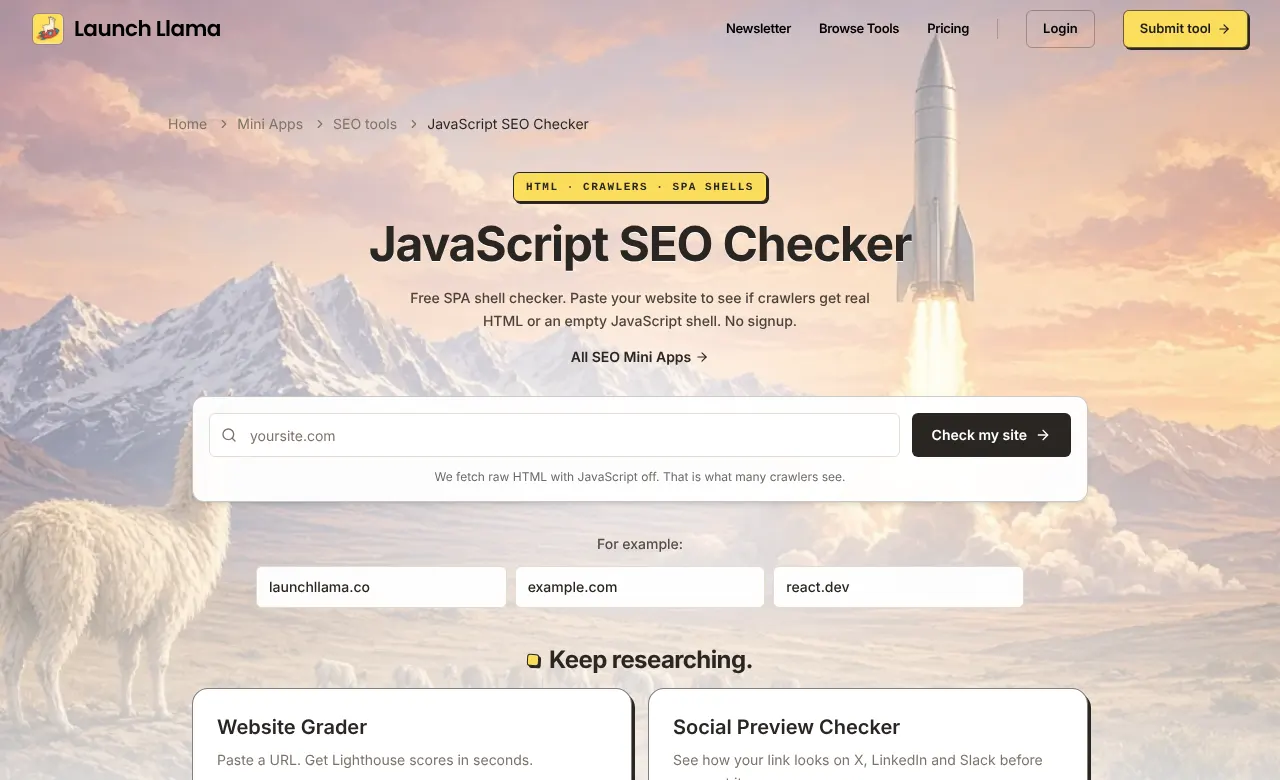
- Check that your pages have real HTML. If your site is a JavaScript app, crawlers may see an empty page. Our free JavaScript SEO checker shows what they see.
- Inspect your homepage in Search Console's URL Inspection and request indexing.
- Check robots.txt doesn't block pages you want found, or AI crawlers you want to be found by.
If pages show as "Discovered" or "Crawled – currently not indexed", see why Google isn't indexing your site.
Week 2: the five technical basics (2 hours)
That's most of technical SEO for a small site. Our SaaS SEO checklist walks through the rest.
Weeks 3 to 4: your first links (1 to 2 hours a week)
A new domain has no authority, so Google crawls it rarely and ranks it low. Links from sites it already trusts fix that.
- Launch platforms with permanent pages and dofollow links. On Launch Llama (DR 74), the weekly top 5 get a permanent dofollow backlink.
- Directories: of the 633 we track, 308 are free and 192 have a domain rating of 80 or more.
- Integrations and partners: a listing in the marketplace of a tool you integrate with.
- Guest posts and newsletter features in your niche.
- Free tools people link to naturally.
More in how to get backlinks for a new website with zero DR.
Month 2 onward: write the pages buyers search for (1 page a week)
You don't need a blog post a day. You need the handful of pages that match what buyers type when they're close to choosing:
Write each one properly: answer the question in the first paragraph, show the product, be honest about trade-offs and link to the related pages. One good page a week is 50 a year.
What to skip when you're short on time
- Daily blogging on general topics. It rarely brings buyers.
- Mass-produced pages with a city or keyword swapped in. Google tends to ignore or drop them.
- Keyword stuffing. Write for the reader.
- Buying links from link farms. They can do more harm than good.
- Chasing every SEO tool score. A perfect score on a page nobody searches for is worth nothing.
What we learned on our own site
In November 2026, Search Console listed 1,183 Launch Llama pages as "Crawled – currently not indexed". The causes were ordinary: canonicals that changed after JavaScript ran, generic filler repeated across hundreds of pages, and about 540 newsletter pages in the sitemap that had never had a single search impression. The fixes were one consistent canonical per page, facts only that page has instead of filler, and a sitemap with only the pages that deserve to rank. Small sites have the same problems at a smaller scale: a blog with ten thin posts, tag pages that duplicate each other, or a JavaScript app that serves an empty shell. The full list is in why Google isn't indexing your site.
A 30-minute weekly SEO routine
Then one new buyer-focused page a week or every two weeks when you can.
Keep reading
- Google Isn't Indexing Your Site? "Discovered" and "Crawled – Currently Not Indexed" Fixed, From Our Own 1,183 Pages (2026)
- New Website, Zero Backlinks? How to Get Your First Backlinks (2026)
- How to Get Your Startup Recommended by ChatGPT, Claude and Perplexity (AI Search for Founders, 2026)
- Website Getting No Traffic After Launch? Why, and a 30-Day Fix (2026)
Frequently asked questions
How long does SEO take for a startup?
Usually weeks to months. A new domain needs to be indexed and earn some links before it ranks, so start early and keep it small.
What's the most important SEO task for a new site?
Making sure Google can index your pages: Search Console set up, a clean sitemap, and real HTML that doesn't depend on JavaScript to show content.
Do I need a blog for SEO?
Not a daily one. A handful of pages that match buyer searches (alternatives, comparisons, use cases, how-to answers) usually brings more customers than general posts.
How do I get backlinks with no audience?
Start with launch platforms and directories with dofollow links. Of the 633 directories we track, 192 have a domain rating of 80 or more.
Can I do SEO myself without an agency?
Yes, for an early-stage startup. The basics in this guide take about an hour a week.
Get your first strong link
A DR 74 listing, live on your date.
Instant Launch puts your listing live on the day you choose, with a permanent dofollow backlink and guaranteed Google Search Console indexing. $39 one time.
See Instant Launch →