On Launch Llama
Zerg Router
Run DeepSeek in Codex
Built by Byron Alsberg
Freemium
Visit website → Upvotes · 77



About
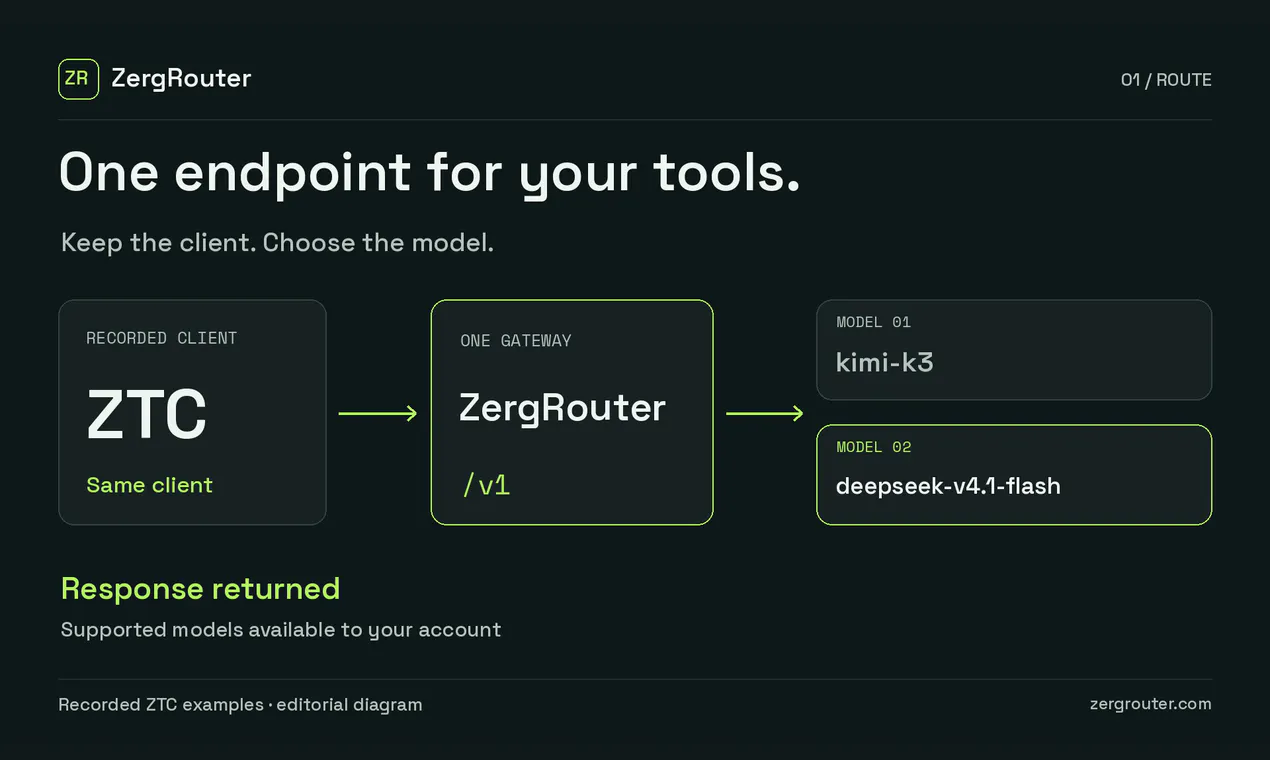
One OpenAI-compatible endpoint for all your coding agents. The routing policy lives in your account, not inside each tool. • Run DeepSeek 4.1 Flash (or other models) inside Codex, and keep your workflow • Give every API key its own daily budget, enforced per request • Explicit fallbacks: on a 5xx, 429 or timeout, try your next model • See remaining weekly quota and reset dates across Codex accounts Supports paid usage, or bring your own provider keys.
Ask AI
ChatGPT Claude Perplexity Grok
For agents
llms.txt · llms-full.txt · ai.txt · Live fact sheet · Full catalog (.md) · Endpoint index · API spec · REST access · Agent server · Server manifest · Server discovery
Key Features
- Route requests through one endpoint to multiple models
- Set daily budgets for individual API keys
- Monitor quotas and reset times across Codex accounts
- Configure fallback chains between models on errors
Use Cases
- Developers using Codex who want to run DeepSeek models while keeping their existing workflow
- Teams managing multiple coding agents that need centralized API budget control
- Organizations using multiple Codex accounts needing visibility into subscription quotas
Pricing
Free trial available with $1 of usage or 5M tokens. Paid DeepSeek access is pay-as-you-go with no monthly base fee at $0.30 per 1M input tokens, $0.03 per 1M cached input tokens, and $1.20 per 1M output tokens.
FAQ
What is Zerg Router?
One OpenAI-compatible endpoint for all your coding agents. The routing policy lives in your account, not inside each tool. • Run DeepSeek 4.1 Flash (or other models) inside Codex, and keep your workflow • Give every API key its own daily budget, enforced per request • Explicit fallbacks: on a 5xx, 429 or timeout, try your next model • See remaining weekly quota and reset dates across Codex accounts Supports paid usage, or bring your own provider keys.
What are the key features of Zerg Router?
Zerg Router includes: • Route requests through one endpoint to multiple models • Set daily budgets for individual API keys • Monitor quotas and reset times across Codex accounts • Configure fallback chains between models on errors • Track usage by model, date, and client application
What can I use Zerg Router for?
• Developers using Codex who want to run DeepSeek models while keeping their existing workflow • Teams managing multiple coding agents that need centralized API budget control • Organizations using multiple Codex accounts needing visibility into subscription quotas
How much does Zerg Router cost?
Free trial available with $1 of usage or 5M tokens. Paid DeepSeek access is pay-as-you-go with no monthly base fee at $0.30 per 1M input tokens, $0.03 per 1M cached input tokens, and $1.20 per 1M output tokens.
What category does Zerg Router belong to?
Zerg Router is listed under Unified API on Launch Llama.
How do I get started with Zerg Router?
Click the "Visit Website" button on this page to go directly to Zerg Router. You can also upvote and leave a review to help other founders discover it.
Reviews
No reviews yet — be the first
Alternatives
- OfoxAI
For developers: OfoxAI gives you one API key to access 100+ LLMs through a single OpenAI-compatible endpoint so you stop juggling multiple provider accounts.
- UnoRouter
For developers: UnoRouter routes requests across 295+ AI models through one OpenAI-compatible API so you switch providers without rewriting code.
- ModelRouter
For AI developers: ModelRouter routes requests across GPT, Claude, and Gemini through one API so you compare performance and costs before scaling.
- Zro
For developers: Zro runs fast, optimized open-model inference across multi-region infrastructure with zero request retention so coding agents execute privately and securely.
- PrimeClaws VPS
For AI builders: PrimeClaws deploys your agent online in 60 seconds with zero DevOps, so it runs 24/7 across Telegram, WhatsApp, Slack, Discord, and iMessage.
- TrustedRouter
For AI teams: TrustedRouter routes requests across hundreds of models through one OpenAI-compatible API so you get privacy, failover, and no prompt logging.