GoModel
For engineers: GoModel is a self-hosted AI gateway supporting every LLM provider with budgets, caching, and failover so you control costs and avoid vendor lock-in.
Built by Jakub A. Wąsek · Free
GoModel is a Product Hunt listing on Launch Llama with 128 total upvotes, founded by Jakub A. Wąsek who joined in Sep 2026, compared against 5 alternatives.
Product Hunt listing
Listing status
128upvotes
Community score
Jakub A. Wąsek (Joined Sep 2026)
Founder
Compared against 5 alternatives
Market comparison
Launched on Launch Llama May 13, 2026 · #3 of 54 that day


About
GoModel is an open-source AI gateway written in Go that provides a single OpenAI- and Anthropic-compatible endpoint for 33 AI providers. It helps teams decouple their applications from specific AI providers through unified routing, caching, budgets, audit logs, and usage tracking.
Launch Llama's Take
Based on Launch Llama data as of
GoModel has 128 upvotes, including the votes it received on Product Hunt. It has been listed on Launch Llama since September 2026. No Launch Llama members have upvoted it yet and it has no reviews yet.
GoModel vs Experiential Labs
GoModel is an open-source AI gateway that provides a single OpenAI- and Anthropic-compatible endpoint, with routing, caching, budgets, and audit logs. Experiential Labs is also an open source gateway, but its listing centers on an intelligence layer that optimizes model selection based on traffic patterns, while GoModel's listing highlights logging each request with its route and provider attempts.
| GoModel | Experiential Labs | Pebbles Ai | EachAPI | |
|---|---|---|---|---|
| What it does | For engineers: GoModel is a self-hosted AI gateway supporting every LLM provider with budgets, caching, and failover so you control costs… | For AI teams: Experiential learns from your traffic to cut costs, recommend better models, and train a specialized model you own. | For B2B revenue teams: Pebbles AI orchestrates strategy, lead generation, outreach, and sales in one workspace so you execute campaigns w… | Route AI model requests through a single unified interface |
| Pricing | Free | Freemium | Freemium | Not stated |
| Free plan | Yes, free to use | Yes, free plan | Yes, free plan | Not stated |
| Category | Unified API | Unified API | Sales | Unified API |
| Upvotes on Launch Llama | 128 | 125 | 431 | 20 |
| Listed on Launch Llama | September 2026 | September 2026 | July 2026 | November 2026 |
Key Features
- Route requests across 33 AI providers behind one API endpoint
- Cache exact-match responses and semantic responses via vector databases
- Enforce spend limits per user path or label before dispatch
- Log every request with resolved route, workflow, and provider attempts
- Automatically failover to alternative providers on errors
- Apply scoped workflows that vary behavior by provider, model, or user
Use Cases
- Teams that need to switch AI providers without changing application code
- Organizations tracking AI costs across multiple teams and features
- Applications requiring different caching and audit rules for different user paths
Who it is for
- Engineers building applications that call multiple LLM providers and want to avoid vendor lock-in
- Engineering teams that need to control and attribute AI API costs across teams or tenants
- Platform or DevOps teams who want a self-hosted, open-source AI gateway they can run as a single binary
Pricing
GoModel is free to use. See the website for details.
FAQ
What is GoModel?
GoModel is an open-source AI gateway written in Go and released under the MIT license. Your apps talk to one OpenAI- and Anthropic-compatible endpoint, and the gateway handles provider routing, model aliases, scoped workflows, caching, failover, budgets, rate limits, audit logs, and usage tracking behind it. It ships as a single small binary with an embedded admin dashboard, so there is nothing else to deploy.
Can I keep using the OpenAI or Anthropic SDK with GoModel?
Yes - in most cases you only change the base URL. GoModel serves the OpenAI API (/v1/chat/completions, /v1/responses, embeddings, files, batches) and the Anthropic Messages API (/v1/messages) natively, so the OpenAI SDK, the Anthropic SDK, and plain HTTP clients all keep working while routing, caching, and usage visibility move into the gateway.
Which AI providers and models does GoModel support?
34 providers, including OpenAI, Anthropic, Google Gemini and Vertex AI, Azure OpenAI, Amazon Bedrock, OpenRouter, Cohere, Groq, xAI, DeepSeek, and open models through Ollama, vLLM, SGLang, and llama.cpp. GoModel reads hundreds of models from live provider catalogs. You can register multiple API keys per provider for round-robin rotation, and any other OpenAI-compatible backend can join as its own provider instance.
How does GoModel compare to LiteLLM?
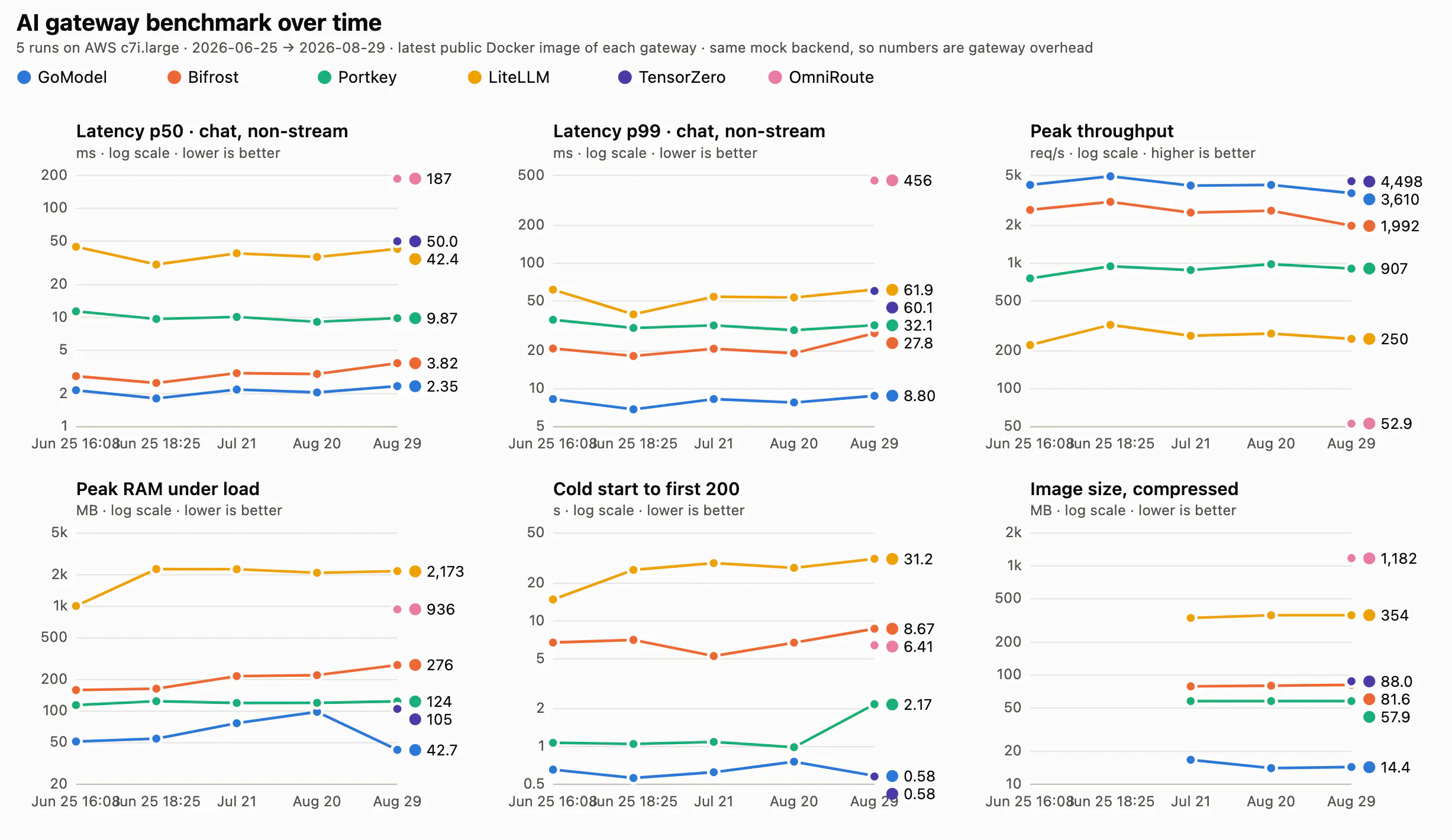
In the reproducible September 2026 benchmark on the same AWS box, GoModel answered in 2.22 ms at the median vs 55.76 ms, sustained 4,498 req/s vs 220, peaked at 73.6 MB of RAM vs 1,488 MB, and cold-started in 0.81 s vs 26.77 s. LiteLLM still supports more providers today - the trade-off is runtime footprint on the request path, which matters most at high volume, on small machines, or in front of fast local models.
What do scoped workflows control?
A workflow toggles cache, audit logging, usage tracking, budgets, guardrails, and failover per provider, model, or user path - the most specific matching scope wins. Workflow versions are immutable, so you can see exactly which policy a given request ran under. One gateway, different runtime policies for different workloads.
Does GoModel cache LLM responses?
Yes, two ways. Exact-match caching returns identical non-streaming requests straight from the gateway - no provider call, no cost. Semantic caching goes further by matching similar prompts, backed by Qdrant, pgvector, Pinecone, or Weaviate. Cache lookups run after alias and workflow resolution, so policy decisions still apply, and cache hits are visible in the dashboard.
Can I track AI usage and cost per team, tenant, or feature?
Yes. Tag requests with X-GoModel-User-Path or labels from virtual API keys, and GoModel records tokens and dollar cost per request against that path. The dashboard breaks spend down by team, tenant, model, and label, pricing overrides keep numbers accurate when your contract differs from list prices, and budgets enforce hard spend limits before a request is ever dispatched.
What happens when a provider goes down?
GoModel retries with backoff, trips a circuit breaker on repeated failures, and fails over to the next configured model or provider - skipping routes that are rate-limited or saturated. Every attempt lands in the audit log with the resolved route, so an outage becomes a routing event you can reconstruct rather than a mystery.
Can I use GoModel with local models via vLLM, Ollama, or LM Studio?
Yes - point OLLAMA_BASE_URL or VLLM_BASE_URL at your server and local models sit behind the same endpoint as the cloud providers. LM Studio, llama.cpp, and similar servers connect the same way through their OpenAI-compatible endpoints. Because the gateway itself is a 21 MB image that peaks at about 74 MB of RAM under load, it is cheap enough to run next to the models - on a laptop, an edge box, or a sidecar.
How do I deploy and operate GoModel?
The fastest path is one docker run; Docker Compose, Kubernetes with the Helm chart, and the plain binary all work too. Storage starts on SQLite with zero setup and moves to PostgreSQL or MongoDB when traffic and retention grow. Operations run through the embedded admin dashboard and API, with Prometheus /metrics and health endpoints for your existing monitoring.
Alternatives
 EachAPIHelps developers send LLM API calls through one gateway so they can reach multiple AI model providers from a single integration without managing each vendor separately.
 AgynFor teams: Agyn runs AI agents in secure sandboxes with spend caps and audit trails so your organization can deploy agents safely without security or finance risk.
 One API for the World’s Leading AI ModelsFor developers: API-Route provides one OpenAI-compatible gateway to GPT, Claude, Gemini, and other models so you switch AI providers without code changes.
New on Launch Llama
Launched this week · This month's launches · All products A–Z
Featured in
Ask AI about GoModel
For bots & AI agents
Machine-readable versions of GoModel and Launch Llama. Fetch these instead of parsing this page.
This listing (.md) llms.txt llms-full.txt ai.txt Full catalog (.md) Endpoint index API docs MCP server MCP manifest Developer docs