Camprtron
For campers: Camprtron matches your vehicle and style to thousands of campsites nationwide so you find your perfect trip in minutes.
Built by Inglehoff · Paid
Camprtron is a Community listing on Launch Llama with 2 total upvotes, founded by Inglehoff who joined in Jun 2026, compared against 3 alternatives.
Community listing
Listing status
2upvotes
Community score
Inglehoff (Joined Jun 2026)
Founder
Compared against 3 alternatives
Market comparison
Launched on Launch Llama Jun 18, 2026 · #23 of 35 that day
About
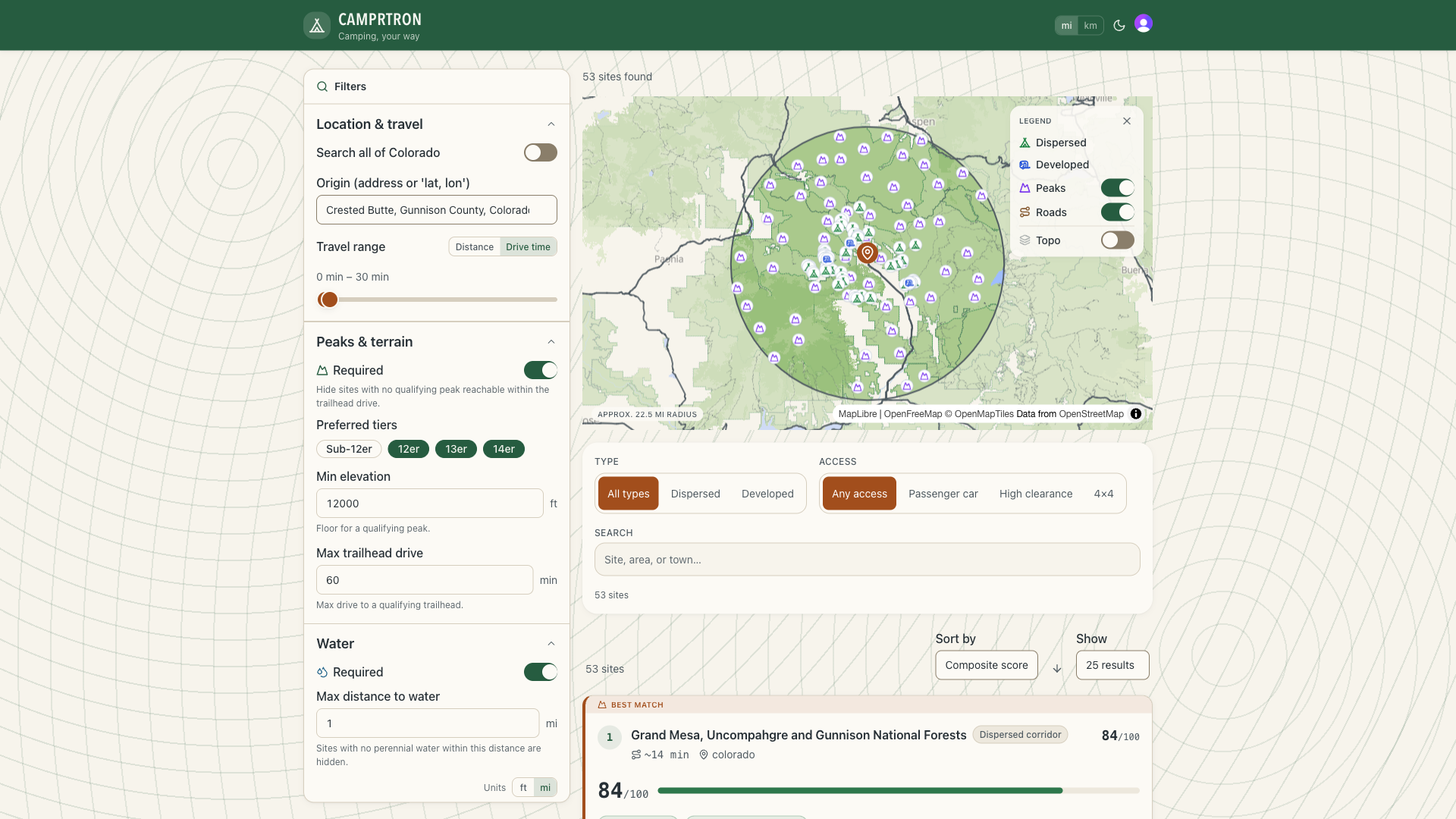
Camprtron is the camping discovery engine built for how people actually camp today. Whether you're a weekend wanderer seeking solitude, a family looking for developed sites with amenities, an RV explorer, or a backcountry adventurer, Camprtron matches you with the best fit from thousands of dispersed and developed campsites nationwide. Available now for Colorado with rapid expansion to all 50 states.
How It Works
Start with your trip essentials: origin location, desired range by distance or routed drive time, your vehicle type, and your camping style. Choose what matters for this specific trip. Maybe you're chasing fishing this weekend, or you need privacy and water access for an extended stay. Whatever drives your camping decisions, Camprtron ranks sites for you.
Smart Scoring
Camprtron's scoring engine evaluates every candidate site across seven dimensions: proximity to mountain peaks, water access quality, privacy from roads and neighbors, fishing potential, nearby hiking trail density, mountain bike terrain accessibility, and actual drive time from your origin. Each criterion is weighted independently so results reflect your actual priorities, not generic popularity. Need a car-accessible river site within two hours? Done. Want the most isolated dispersed camping with stunning views? We'll find it.
Vehicle Matching
Our platform understands your actual access capabilities. We catalog vehicle specifications including clearance, suspension type, and terrain ratings. We evaluate each site's access type against your vehicle's capability so you know what's truly accessible. No more locked gates or washed-out roads catching you off-guard. Your vehicle's real constraints inform your planning, not hidden surprises.
Complete Trip Context
Every site includes layered information: nearest town and distance, water feature type and distance, seasonal closures and access restrictions, reservation availability for developed sites, and trail access summaries. Available on web with native iOS and Android apps coming soon. Works online and offline with locally cached data. Built with privacy first: your search history and vehicle details never touch third-party trackers. Trip planning simplified.
Follow Camprtron: X (Twitter)
Use Cases
- Finding free dispersed camping spots near mountain biking, kayaking, fly fishing, or hiking trails before a trip
- Checking whether a passenger car, high-clearance vehicle, or 4x4 can reach a campsite before driving there
- Planning a weekend trip within a set drive time from your starting point, prioritizing water or fishing access
Who it is for
- Campers and RV owners looking for reservable developed campgrounds with hookups near their destination.
- Outdoor enthusiasts such as mountain bikers, kayakers, anglers, and hikers who want campsites close to their activities.
- Off-road and backcountry drivers who need to know which campsites their vehicle can access.
Pricing
Every new account gets a 3-day free trial with no card required. After that, plans are $5.99 a month or $49 for the year (about $4.08 a month).
FAQ
What is Camprtron?
Camprtron is a campsite finder that ranks free dispersed (boondocking) and reservable developed campsites by the peaks, water, fishing, and trails near camp within your drive time and with your vehicle's road access factored in. Coverage spans 50 states across the Mountain West, New England, Texas, the Pacific Northwest, California, the Great Plains, the Mid-Atlantic North, the Northwoods, the Ozarks, Appalachia North, Appalachia South, the Gulf South, the Ohio Valley, Alaska, and Hawaii, expanding toward all 50.
Who is Camprtron for?
Camprtron is built for anyone who picks a campsite by what is around it rather than by a name on a list: tent campers and car campers looking for free dispersed sites on National Forest or BLM land, van and truck-camper travelers who need to know what a road demands before they drive it, trailer and RV owners who have to match a rig to a road access tier and a posted length limit, and anglers, hikers and mountain bikers who want to camp close to the water or a trailhead. It suits trip planning better than same-night booking, because it ranks a whole region against your origin and drive time instead of listing one campground at a time.
How much does Camprtron cost?
Camprtron costs $5.99 a month or $49 a year. Every new account starts with a 3-day free trial that never asks for a card; when the trial ends, a plan is what keeps search working. The pricing page has the full details.
Can I download or reuse Camprtron’s camping data?
Yes. The public field set is published as a free dataset at camprtron.com/data/download, as CSV or JSON, one file per state. It is licensed CC BY 4.0, so you may use it commercially, modify it and redistribute it, provided you credit Camprtron and link back. Vehicle suitability verdicts, trip rankings, exact coordinates and live availability are not included, and coordinates are rounded to about one kilometre.
Which states does Camprtron cover?
Camprtron covers 50 states across the Mountain West, New England, Texas, the Pacific Northwest, California, the Great Plains, the Mid-Atlantic North, the Northwoods, the Ozarks, Appalachia North, Appalachia South, the Gulf South, the Ohio Valley, Alaska, and Hawaii today. We are adding states as we grow, with all 50 states as the long-term goal. The data coverage page lists the exact site counts loaded per state.
What is the difference between dispersed and developed camping?
Dispersed camping (boondocking) means camping outside a designated campground on public land, National Forest or BLM, with no hookups, reservations, or fees in most cases. Developed campgrounds are designated sites with amenities such as fire rings, vault toilets, and sometimes water; they typically charge a nightly fee and many are reservable in advance.
What is boondocking?
Boondocking is the informal, vehicle centric term for dispersed camping on public land: self contained, without hookups, usually free. The U.S. Forest Service and BLM use the term "dispersed camping" in their regulations; boondocking emphasizes the off grid, self sufficient aspect. For a full explanation of the rules, vehicle requirements, and Leave No Trace practices, read the full guide.
Is dispersed camping free?
Yes on most National Forest and BLM land there is no nightly fee and no reservation required. A handful of high use dispersed zones require a free permit. Developed campgrounds charge a nightly fee; many require advance reservations through recreation.gov.
Is dispersed camping banned anywhere?
No state bans it outright. The restrictions that do exist are narrower: they cover an area drawn in a forest order, a named road, a season, or how many nights you can stay. Two places on our list ban camping along their roads altogether, and a stay limit is regularly mistaken for a ban.
Can I camp on state land, not just National Forest or BLM?
Sometimes, and it changes at every state line. Some states let you camp on their own land with nothing to pick up first, some want a permit, some keep you to marked sites, and a few have no state land you can camp on at all. Wildlife Management Areas are the usual trap: most states ban camping on them.
Alternatives
 MagrifyMagrify builds booking-ready websites, SEO, and automation for RV parks, campgrounds, vacation rentals, and property managers. Based in Dallas, Texas since 2021.
New on Launch Llama
Launched this week · This month's launches · All products A–Z
Ask AI about Camprtron
Supporters
1 founder
1 founder supported Camprtron on Launch Llama.
For bots & AI agents
Machine-readable versions of Camprtron and Launch Llama. Fetch these instead of parsing this page.
This listing (.md) llms.txt llms-full.txt ai.txt Full catalog (.md) Endpoint index API docs MCP server MCP manifest Developer docs