Codex Stellarum
For developers: Codex Stellarum transforms your GitHub contribution history into a vintage star atlas so you visualize your coding journey as celestial art.
Built by Enrico Faccioli · Developer Tools · Design Tools · Freemium
In category: #675 of 931 · Developer Tools
Codex Stellarum is a Instant Launch listing on Launch Llama with 2 upvotes from 2 founders, founded by Enrico Faccioli who joined in Jun 2026, compared against 6 alternatives.
Instant Launch listing
Listing status
2upvotes
Community score
Enrico Faccioli (Joined Jun 2026)
Founder
Compared against 6 alternatives
Market comparison
Launched on Launch Llama Jun 7, 2026 · #23 of 24 that day


About
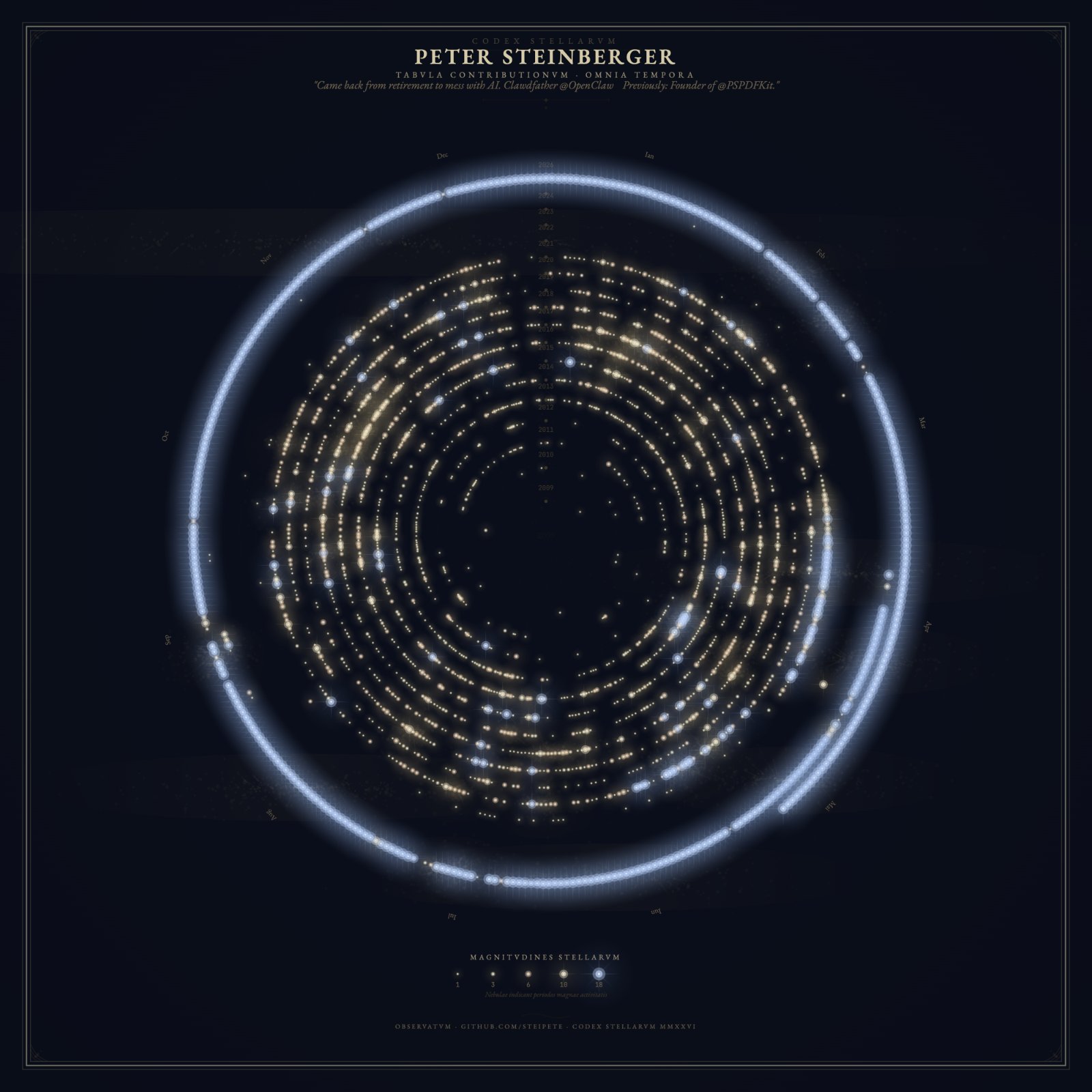
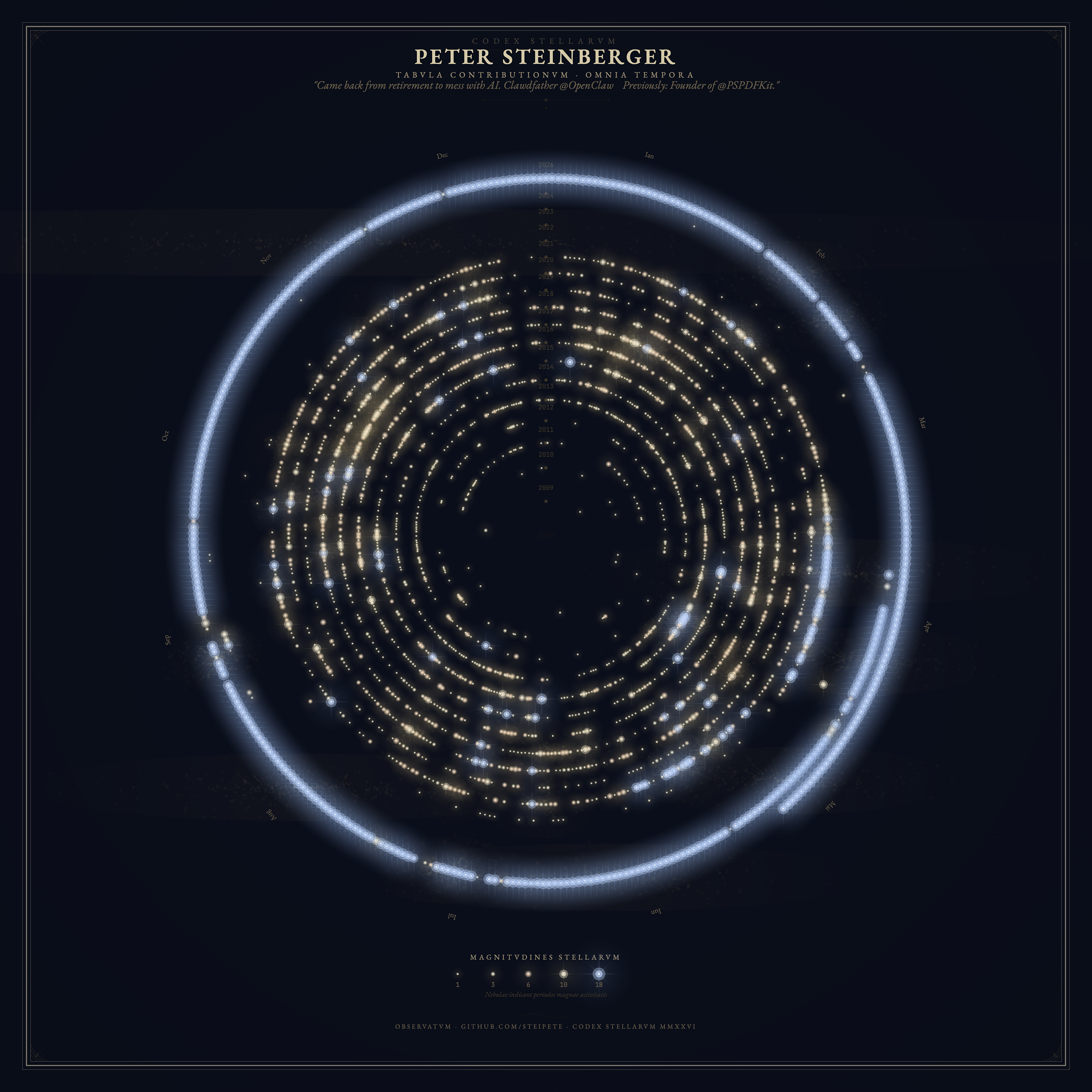
Codex Stellarum turns your GitHub contribution history into a vintage star atlas, inspired by 17th-century celestial cartography. Every day you wrote code becomes a star. Busy days burn bright, quiet days sit faint, and the dark spaces are part of the story. Generate a free preview of any profile, organisation, or repository. Download the digital file from £10, or order an archival giclée print on 200 GSM cotton rag paper from £25.
Follow Codex Stellarum: X (Twitter) · LinkedIn
Key Features
- Every commit becomes a star
- Organisation atlases
- Museum-grade prints
Use Cases
- Team gifts that are not branded water bottles. Generate an atlas for each engineer from their public contributions. It costs less than most conference swag and
- An office wall instead of a Jira board. Chart your whole organisation's GitHub activity into one print for the meeting room
- A milestone marker. Hand one to a developer on a work anniversary, a first shipped product, or the day they leave
- A founder's own record. The nights and weekends that built the company, rendered as a star chart rather than a burndown
Who it is for
Working developers who have shipped years of code that nobody will ever see, and want something to hold for it. Open source maintainers whose contribution history is long enough to look like a real sky. People buying for a developer who do not know what GitHub is, but know what belongs on a wall. En
- Working developers with years of shipped code and nothing to show for it.
- Open source maintainers whose history is long enough to look like a real sky.
- People buying for a developer who know what belongs on a wall.
- Teams and founders charting a whole organisation's history into one atlas.
- Career switchers marking their first developer role.
Pricing
Digital download: £10, maximum resolution, delivered by email. Fine art prints from £25, on 200 GSM archival cotton rag paper with 300 DPI giclee printing. Sizes range from 30cm square to A1. Organisation atlases available for teams. Printed by Prodigi at the fulfilment centre closest to your address and shipped to most countries.
Verdict
Most attempts to make a contribution graph physical print the green grid on a poster. It looks like a screenshot, and it belongs in a developer cave rather than on a living room wall. Codex Stellarum starts from the opposite idea. A non-developer sees the print and thinks it is beautiful. A developer looks closer and realises those are their own contributions. That gap is the whole point. If you have spent years writing code that vanishes the moment it ships, this is one of the few ways to keep a record of it that someone else would want to look at.
FAQ
Why would I put my code on a wall?
Most of what we build as developers disappears into production. Tickets close, repositories archive, companies move on. But the rhythm of your work - the late nights before a launch, the quiet weeks between projects, the years of steady effort - that is still there in your contribution history. Every day you contributed becomes a star. Busy days are large and luminous, quiet days are small and faint. Codex Stellarum renders that history not as a grid of coloured squares or a screenshot from a website, but as a star atlas inspired by 17th-century celestial cartography - the kind of object that belongs in a frame next to actual art, not next to the rubber ducks. A non-developer sees it and thinks "that is beautiful." A developer sees it and thinks "wait - those are my contributions." We wrote more about the thinking behind it in our founding essay. in our founding essay at https://codexstellarum.com/blog/why-we-built-codex-stellarum
What if most of my commits are in private repositories?
Your atlas is generated from the contribution data visible on your public GitHub profile. To include private contributions, go to your GitHub profile, click "Contribution settings" next to your contribution graph, and enable "Private contributions". This changes only the count displayed on your profile - your code and repositories remain completely private. You can enable it just long enough for us to fetch your data, then turn it off again.
Can I buy this as a gift for a developer?
You can. All you need is their GitHub username. Enter it on the chart page, choose a layout and theme, and place the order. We ship to most countries globally with tracked delivery.
How is this different from a screenshot of my GitHub profile?
A GitHub profile shows a flat grid of green squares for the past year. We transform your entire contribution history - every year you have been coding - into a star atlas rendered in the visual language of celestial cartography. Three astronomical layouts. Period-appropriate Latin typography. A magnitude legend. Coordinate markings. Each day becomes a star whose size and brightness reflect your activity. The result is printed on museum-quality 200 GSM archival cotton rag paper at 300 DPI using the same giclée process used by galleries. It is designed to look like something from a rare book collection, not from a computer screen.
Where do you ship to?
Most countries globally. Your print is produced at the fulfilment centre closest to your shipping address, reducing delivery times and carbon emissions. Orders are typically dispatched within 2-5 business days. Delivery is then 2-4 business days for UK orders and 4-10 business days for international orders.
What if I am not happy with my print?
If anything is wrong with your order - print quality, shipping damage, or otherwise - email [email protected] within 14 days and we will make it right. No forms, no tickets. Full details in our refund policy.
Alternatives
 GitRacingFor developers: GitRacing gamifies GitHub activity so your team stays motivated through commits, stars, and pull requests.
Ask AI about Codex Stellarum
Supporters
2 founders
2 founders contributed 2 upvotes to Codex Stellarum on Launch Llama.