On Launch Llama
Scholar Sidekick - Free citation API for 10,000+ styles
For researchers and developers: Scholar Sidekick resolves citations from DOI, PMID, and arXiv into 10,000+ styles via free API and MCP.
Built by Mark Lavercombe
Developer Tools SaaS Education Free
Visit website → Upvotes · 3
In category: #1084 of 1317 · Developer ToolsTrending this week: #763 of 1317 · Developer Tools
Scholar Sidekick is a Instant Launch listing on Launch Llama with 3 total upvotes across 2 founder supporters, founded by Mark Lavercombe who joined in May 2026, compared against 6 alternatives.
Instant Launch listing
Listing status
3upvotes
Community score
Mark Lavercombe (Joined May 2026)
Founder
Compared against 6 alternatives
Market comparison
About
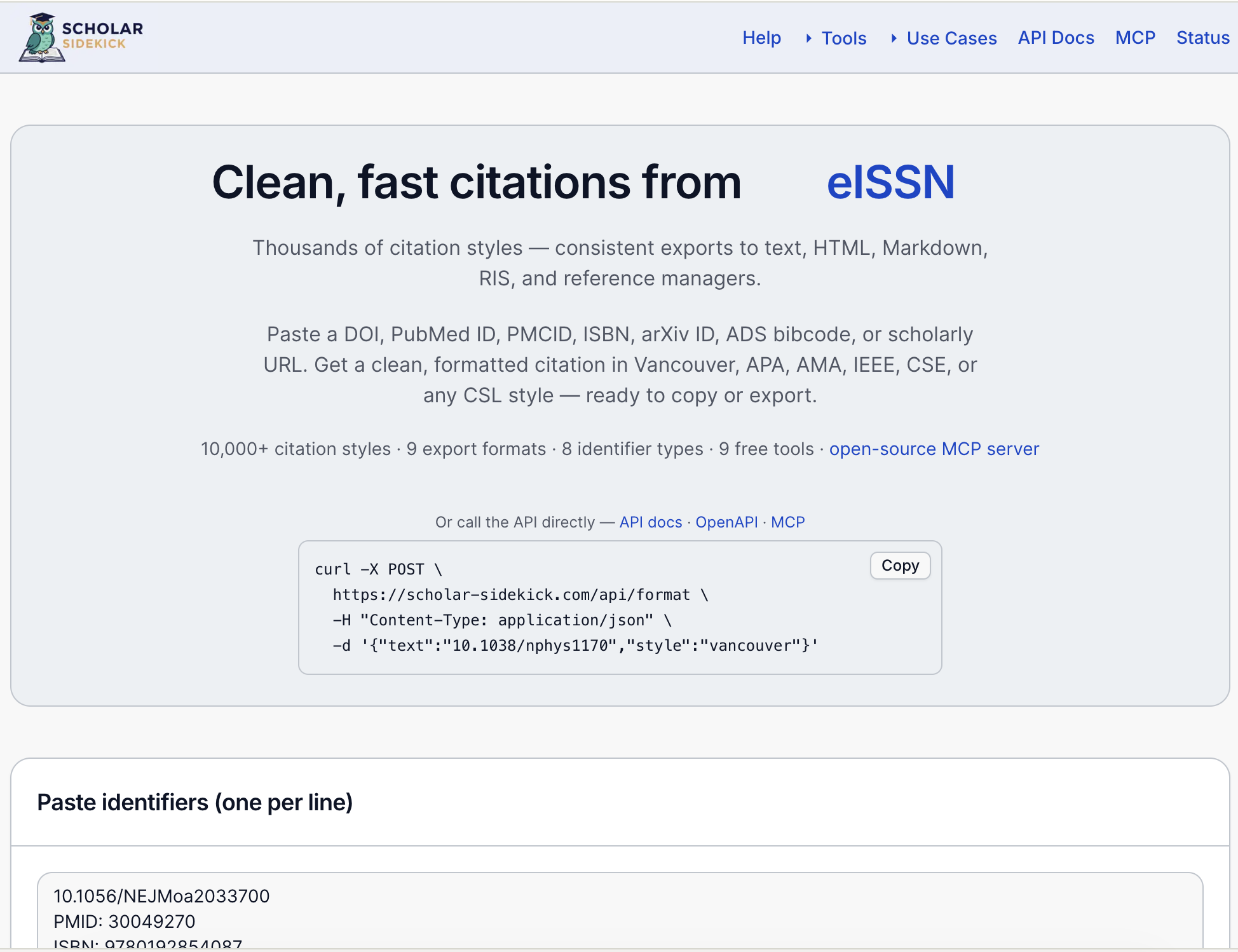
Free citation API and first-party MCP server. Resolves DOIs, PMIDs, PMCIDs, ISBNs, ISSNs, arXiv IDs, ADS bibcodes, and WHO IRIS URLs into 10,000+ CSL styles. Identifier-first, deterministic via x-scholar-transform-version, with a public source manifest. Works with Claude, Cursor, and Windsurf via MCP.
Ask AI
ChatGPT Claude Perplexity Grok
For agents
llms.txt · llms-full.txt · ai.txt · Live fact sheet · Full catalog (.md) · Endpoint index · API spec · REST access · Agent server · Server manifest · Server discovery
Key Features
- Delivers free citation API + first-party MCP server (Claude, Cursor, Windsurf)
- Surfaces DOI, PMID, PMCID, ISBN, ISSN, arXiv, ADS bibcode, WHO IRIS URL
- Delivers 10,000+ CSL citation styles (APA, MLA, Chicago, Vancouver, AMA, IEEE, and the rest of
- Delivers deterministic output via x-scholar-transform-version, audit-grade reproducibility
Use Cases
- Wire deterministic citation generation into an LLM agent or AI research-assistant product
- Add DOI / PMID / arXiv resolution to a knowledge-management SaaS without writing scrapers
- Embed bibliography export (BibTeX, RIS, EndNote XML) in a writing or note-taking app
- Build a systematic-review automation pipeline that resolves thousands of references reproducibly
- Drop the MCP server into Claude, Cursor, or Windsurf so customers can ask for citations in natural language
Pricing
Free anonymous tier at scholar-sidekick.com — no signup, no API key, all 10,000+ CSL styles, nine free tools, MCP server included. Paid plans via RapidAPI scale from a free 500-requests/month key up to enterprise volumes. No per-style paywall, no Word-export upsell, no plagiarism prompts.
Verdict
Scholar Sidekick turns scholarly identifiers (DOI, PMID, PMCID, ISBN, ISSN, arXiv, ADS, WHO IRIS) into formatted citations across 10,000+ CSL styles — available as a free REST API, a first-party MCP server (Claude / Cursor / Windsurf), and nine free web tools. The architectural distinction: most citation generators scrape URLs you paste; Scholar Sidekick resolves identifiers live from authoritative registries (Crossref, PubMed, DataCite, OpenAlex). Output is deterministic and version-pinned via x-scholar-transform-version — same input, same snapshot, byte-identical citation. Useful for systematic reviews, audits, and any reproducibility-sensitive workflow. Resolver chain is public at /.well-known/sources.json. For AI agent builders, drop the MCP server into Claude, Cursor, or Windsurf via npx with a RapidAPI key and the agent can resolve and format citations in natural language. For researchers and clinicians, broader identifier coverage (PMCID, ADS, WHO IRIS) plus live retraction-watch and open-access checks fill gaps reference managers do not. Honest about scope: this is not a reference manager — no personal library, no Cite-While-You-Write plugin, no in-browser bibliography. Pair with Zotero or EndNote for those. For deterministic, identifier-first citation generation an agent or pipeline can call programmatically, it is purpose-built.
FAQ
What is Scholar Sidekick?
Free citation API and first-party MCP server. Resolves DOIs, PMIDs, PMCIDs, ISBNs, ISSNs, arXiv IDs, ADS bibcodes, and WHO IRIS URLs into 10,000+ CSL styles. Identifier-first, deterministic via x-scholar-transform-version, with a public source manifest. Works with Claude, Cursor, and Windsurf via MCP.
Who is Scholar Sidekick for?
Scholar Sidekick is for anyone whose work touches scholarly citations — AI agent developers wiring citation lookups into LLMs, researchers or clinicians who need authoritative registry metadata, systematic-review teams running batch resolution, and students who want a friction-free generator. • AI agent developers integrating citation lookups into Claude / Cursor / Windsurf • Researchers and clinicians who need authoritative metadata, not URL scraping • Systematic-review teams resolving large batches of identifiers reproducibly • Developers piping DOI / PMID / arXiv ids through scripts, CI jobs, or LLM agents • Students wanting a free citation generator without ads or plagiarism prompts
What are the key features of Scholar Sidekick?
Scholar Sidekick includes: • Free citation API + first-party MCP server (Claude, Cursor, Windsurf) • 8 identifier types: DOI, PMID, PMCID, ISBN, ISSN, arXiv, ADS bibcode, WHO IRIS URL • 10,000+ CSL citation styles (APA, MLA, Chicago, Vancouver, AMA, IEEE, and the rest of the registry) • Deterministic output via x-scholar-transform-version — audit-grade reproducibility • Live retraction-watch and open-access classification (Gold / Green / Hybrid / Bronze) • Nine free tools: DOI Lookup, DOI to BibTeX, DOI to RIS, PMID Converter, Style Comparator, and more
What can I use Scholar Sidekick for?
• Wire deterministic citation generation into an LLM agent or AI research-assistant product • Add DOI / PMID / arXiv resolution to a knowledge-management SaaS without writing scrapers • Embed bibliography export (BibTeX, RIS, EndNote XML) in a writing or note-taking app • Build a systematic-review automation pipeline that resolves thousands of references reproducibly • Drop the MCP server into Claude, Cursor, or Windsurf so customers can ask for citations in natural language
How much does Scholar Sidekick cost?
Free anonymous tier at scholar-sidekick.com — no signup, no API key, all 10,000+ CSL styles, nine free tools, MCP server included. Paid plans via RapidAPI scale from a free 500-requests/month key up to enterprise volumes. No per-style paywall, no Word-export upsell, no plagiarism prompts.
What category does Scholar Sidekick belong to?
Scholar Sidekick is listed under Developer Tools, Education, SaaS on Launch Llama.
How do I get started with Scholar Sidekick?
Click the "Visit Website" button on this page to go directly to Scholar Sidekick. You can also upvote and leave a review to help other founders discover it.
What does Scholar Sidekick do?
It resolves scholarly identifiers (DOI, PMID, PMCID, ISBN, ISSN, arXiv ID, ADS bibcode, WHO IRIS URL) into formatted citations across 10,000+ CSL styles. Available as a free REST API, a first-party MCP server (Claude / Cursor / Windsurf), and nine purpose-built free web tools.
Is it actually free?
Yes. The anonymous tier at scholar-sidekick.com requires no signup, no API key, and covers all 10,000+ CSL styles, all nine free tools, and the MCP server. Paid plans are sold via RapidAPI for higher request volumes — free 500-requests/month tier up to enterprise. No per-style paywall, no Word-export upsell.
How do I use the MCP server?
Install via npx in Claude Desktop, Cursor, or Windsurf with one config block, set a RapidAPI key in the env, and your assistant can resolve and format citations through natural language — no glue code or custom integration. Five MCP tools: resolveIdentifier, formatCitation, exportCitation, checkRetraction, checkOpenAccess.
What makes it different from Cite This For Me, MyBib, or Citation Machine?
Identifier-first vs URL-first. Most citation generators scrape URLs you paste; Scholar Sidekick resolves identifiers live from authoritative registries (Crossref, PubMed, DataCite, OpenAlex). Output is deterministic and version-pinned via x-scholar-transform-version — same input produces byte-identical output across requests. There is also a public REST API and MCP server, which the URL-paste generators do not have.
Can I use it for systematic reviews or audit work?
Yes — that is one of the core use cases. The x-scholar-transform-version response header pins the formatter chain to a specific snapshot, so identical inputs at a fixed version produce byte-identical output. The resolver chain is publicly declared at /.well-known/sources.json, and copy-paste verification curls live at /verification so reviewers can independently confirm reproducibility.
Does it check for retracted papers and open-access status?
Yes — both. Live Retraction Watch integration via /tools/retraction-checker (or the ?checks=retraction flag on /api/format) flags retractions, corrections, and expressions of concern. Live Unpaywall integration via /tools/open-access-checker classifies open-access status (Gold / Green / Hybrid / Bronze) and surfaces a free PDF link when one exists.
Is there a Word plugin or personal reference library?
No. Scholar Sidekick is stateless by design — no library, no Cite-While-You-Write Word plugin, no in-browser bibliography. Pair with Zotero or EndNote for those workflows. Scholar Sidekick is purpose-built for identifier-first resolution, scripting, and agent integration; the comparison pages at /compare/ document where the trade-off makes sense in either direction.
Supporters
2 founders2 founders contributed 3 upvotes to Scholar Sidekick on Launch Llama.

Reviews
2 comments
Honestly, it came from my frustration with existing tools. I didn't like being upsold to plagiarism detectors when I just wanted a formatted citation. And I wanted to be able use my own tools programmatically, and more recently, via AI tools as well. Thus, Scholar Sidekick!
Hey, love seeing this here! 👋 What inspired you to build this? Would love to hear the story behind it.
Alternatives
- ScholarForge AI
For researchers: ScholarForge AI streamlines research and reference management with AI so you write academic papers faster and organize sources efficiently.
- Citeya
For content teams: Citeya generates SEO articles with real citations and quality checks so you publish research-backed content in minutes.
- 1Scholar
For academic writers: 1Scholar verifies citations, finds relevant sources, and humanizes AI text so you publish research faster while maintaining authenticity and academic integrity.
- Buddy AI Access (MCP)
For engineering teams: Buddy AI Access lets Claude, Cursor and Copilot deploy apps, manage infrastructure and run tests directly via MCP.
- PDFtoMarkdown.ai
For developers and AI teams: PDFtoMarkdown.ai converts PDFs to clean Markdown for Claude, ChatGPT, and RAG pipelines so you feed AI better data.
- CiteLens
For content creators: CiteLens analyzes any URL and scores readability in 30 seconds so you optimize content clarity before publishing.